The marketing software that will reliably grow roofing leads and track ROI is the platform that runs Local SEO execution and call attribution in one system, so every call ties back to the keyword, listing, and service area that produced it.
Here’s what matters most when the goal is trackable roofing phone calls:
- Prioritize call attribution tied to Local SEO, not just lead storage.
- Expect early signal in 30 days, with meaningful momentum in 3 to 6 months.
- Multi-location and service area targeting must be built in, not bolted on.
- Google Business Profile optimization workflows drive Map pack visibility and call volume.
- Competitor analysis prevents guessing by showing where your market gaps actually are.
- Weekly reporting should include calls, clicks, and direction requests, not vanity metrics.
We built our National Customer Accelerator (Roofing Edition) to solve the exact disconnect roofers hate: marketing activity without call level attribution. With 15+ years in the field, 1,000+ clients supported, and $50M+ in revenue generated for clients, we focus on measurable customer acquisition from local search, then prove it with reporting you can audit. First, let’s start with the National Customer Accelerator (Roofing Edition) and how it ties call attribution to Local SEO, including calls, clicks, and direction requests from the same workflow.
1. Web Rank Digital National Customer Accelerator (Roofing Edition) for call attribution tied to local SEO
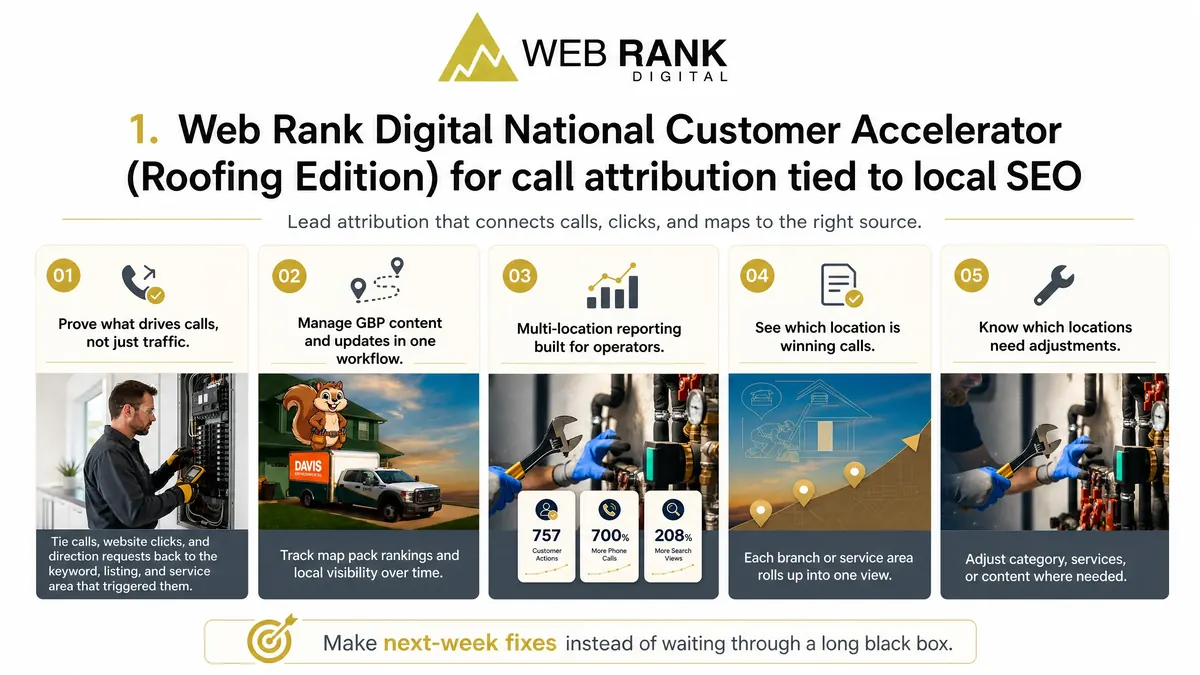
If you are paying for marketing software, you should be able to prove which roofing searches and which Google Business Profile (GBP) listing produced actual phone calls, not just “traffic.” Web Rank Digital’s National Customer Accelerator (Roofing Edition) is built around lead attribution that ties calls, website clicks, and direction requests back to the keyword, listing, and service area that triggered them, so you can make next-week fixes instead of waiting through a long black box.
On the local SEO side, you manage GBP content and updates in one workflow while tracking map pack rankings and local visibility over time. The multi-location reporting is where it gets practical for operators: each branch or service area rolls up into one view, but you can still see which location is winning calls and which needs category, services, or content adjustments.
2. Local Falcon for fast Google Maps visibility testing across a service area
Local Falcon is the specialized pick when your main question is: “How far does our Google Maps visibility actually reach?” It runs geo-grid scans that check map pack rankings at dozens of points, then turns the results into a heatmap so you can see coverage street by street across each city, zip, or service-area edge. That directly addresses multi-location reporting pain because you can compare grids between branches and spot where competitors outrank you in specific pockets. The gap: Local Falcon is not native call attribution, so it will not tell you which grid gains produced phone calls or revenue without a separate call tracking and ROI layer.
3. ServiceTitan for enterprise operations with built-in marketing execution layers
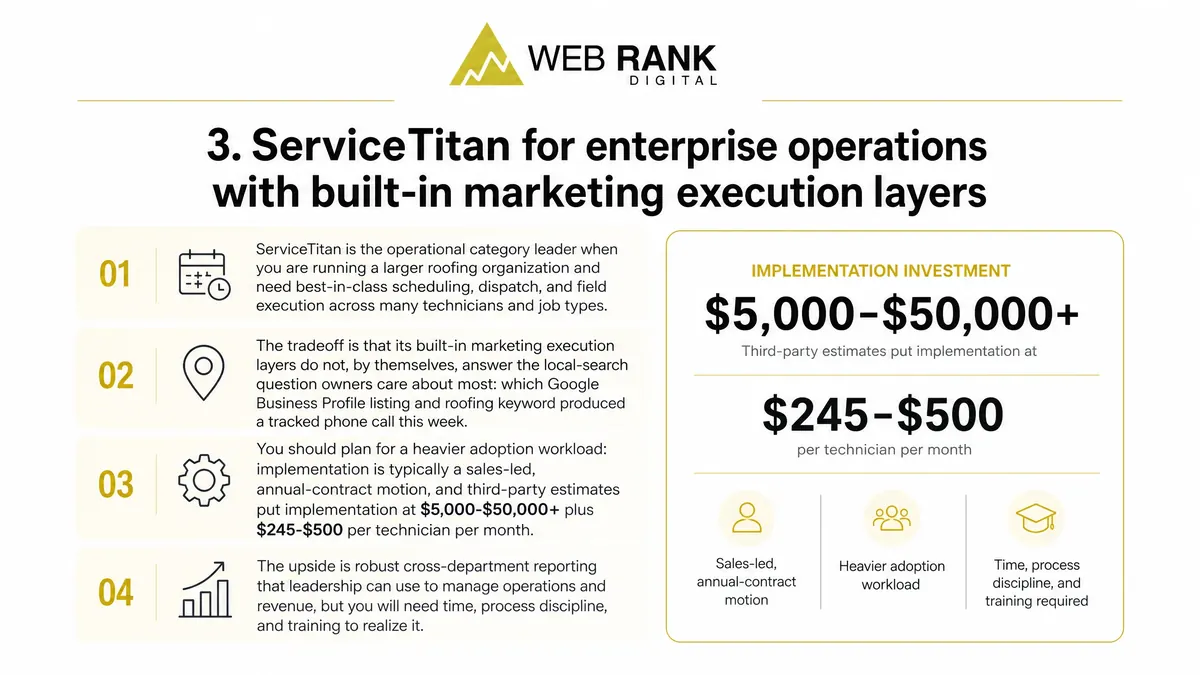
ServiceTitan is the operational category leader when you are running a larger roofing organization and need best-in-class scheduling, dispatch, and field execution across many technicians and job types. The tradeoff is that its built-in marketing execution layers do not, by themselves, answer the local-search question owners care about most: which Google Business Profile listing and roofing keyword produced a tracked phone call this week.
You should plan for a heavier adoption workload: implementation is typically a sales-led, annual-contract motion, and third-party estimates put implementation at $5,000-$50,000+ plus $245-$500 per technician per month. The upside is robust cross-department reporting that leadership can use to manage operations and revenue, but you will need time, process discipline, and training to realize it.
4. JobNimbus for roofing CRM workflows that keep leads from slipping
JobNimbus is strongest when your main bottleneck is follow-up discipline, not lead generation. You get clear lead and job pipeline organization, so every prospect sits in a defined stage and every job moves from inspection to production to closeout without living in someone’s inbox.
For accountability, you can assign owners, set activities, and make next-step tasks visible so reps and office staff know who is on the hook today, not “sometime this week.” That visibility is what stops aging estimates and missed call-backs.
What it does not solve is keyword-to-call attribution from Local SEO. It won’t tell you which Google Business Profile query or map pack keyword produced the phone call.
5. QuoteIQ for estimating and sales process speed from inbound leads
QuoteIQ is strongest when your bottleneck is speed from inbound lead to clean, sent estimate. It supports measurement, estimate creation, and proposal options so you can respond while the prospect is still comparing contractors, and keep follow-up tight inside a sales workflow.
Where teams misclassify it is treating faster quoting as lead generation or attribution. QuoteIQ can help you close more of the leads you already have, but it gives you limited insight into the exact search queries or Google listings that produced those calls.
6. Referral and review platforms for turning completed jobs into trackable introductions
Referral and review platforms only earn their keep if they produce trackable calls, not just “more activity.” Your highest-converting review ask is immediately at job completion, while the crew is packing up and the homeowner can see the result; waiting even a few days adds friction and lowers response rate.
Incentives can work, but you need controls or you will pay for noise: tie rewards to a completed job (not a lead), require a unique referral link or code, limit one reward per household, and manually audit repeat phone numbers and addresses.
The big tracking gap to watch: most tools report referral sources, but cannot connect calls back to the roofing keyword and Google Business Profile interaction that started the journey. In our experience, keep referral tracking in the same workflow as call attribution so you avoid a second black box.
7. Multi-location local SEO suites for service-area pages plus weekly reporting
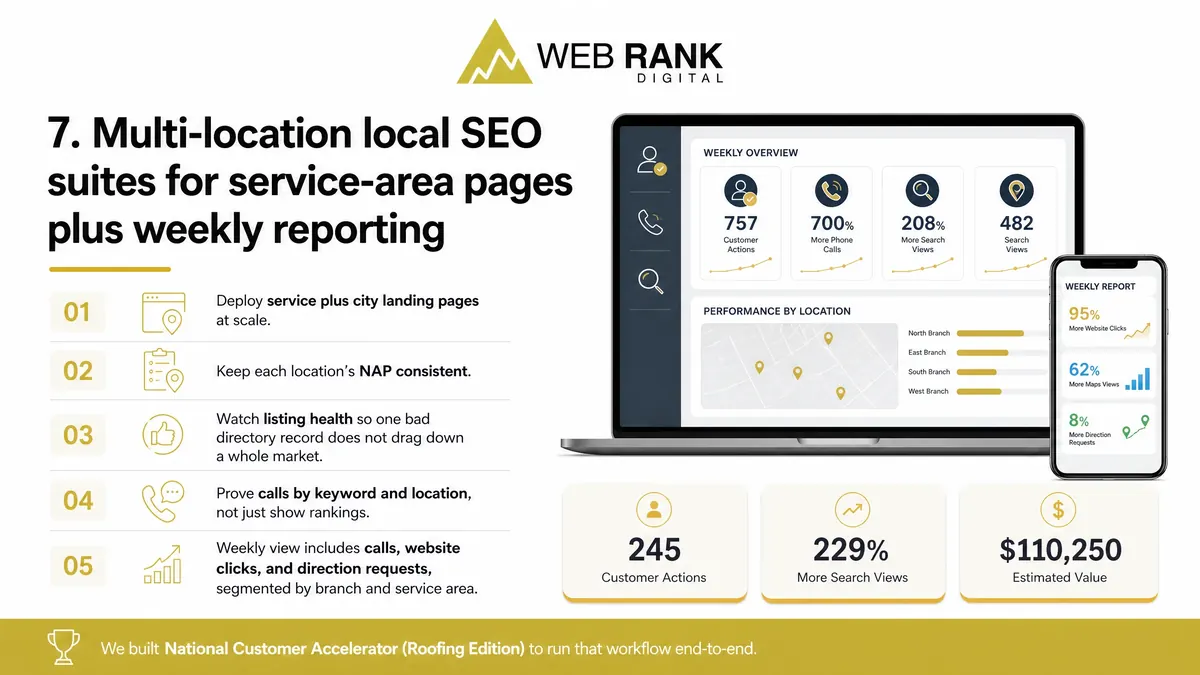
Multi-location local SEO suites are the clean fit when you manage multiple branches or wide service areas and you need reporting that holds up in a weekly ops meeting. You are not just “ranking a website”. You are deploying service plus city landing pages at scale, keeping each location’s NAP consistent, and watching listing health so one bad directory record does not drag down a whole market.
Your decision line is simple: can the platform prove calls by keyword and location, not just show rankings. Your weekly view should include calls, website clicks, and direction requests, segmented by branch and service area, so you can see which “roof repair + city” pages and which Google Business Profile listings actually produced leads. We built National Customer Accelerator (Roofing Edition) to run that workflow end-to-end.
Get a 30-day calls report you can trust
If your current stack cannot tell you which roofing keywords and Google Business Profile updates produced phone calls, you are not running marketing. You are funding guesswork.
We built Web Rank Digital’s National Customer Accelerator (Roofing Edition) to connect Local SEO execution with Lead Tracking and Attribution and competitor gap intel in one workflow. That means you can see calls, clicks, and direction requests tied back to the queries and listings that triggered them, then prioritize next week’s fixes with data.
Book a demo and request a market and competitor scan for your exact service areas. Come prepared with your target cities and services, and ask us to show call attribution tied to roofing keywords plus the first 30-day reporting view for calls, clicks, and direction requests.
Frequently Asked Questions
How quickly will roofing leads come from this software?
You can typically see early traction within about 30 days once your tracking, Google Business Profile workflow, and service-area targeting are set up correctly. In most markets, the compounding gains come from week-to-week optimization over the next few months, not one big change.
Can we track which specific searches result in phone calls?
Yes. With Lead Tracking and Attribution, you can tie inbound calls to the roofing keywords and search queries that drove them, along with related actions like website clicks and direction requests. That is what turns reporting into a practical weekly plan.
Does this work for multi-location roofing companies?
Yes. You can manage multiple locations with defined service areas, location-specific landing pages, and segmented reporting so you know which markets are producing calls. This is critical when performance varies by city, zip code, and competitor density.