The marketing software that gets you more electrician leads and booked jobs is the one that spots where competitors are taking demand in your service area, then runs automated lead capture and follow-up so inquiries do not die in your inbox.
Here’s what matters most if you want more booked jobs, not more logins:
- For a 1 to 4 person shop, simplicity beats feature depth because adoption is the constraint.
- Pick your lane first: residential or commercial, emergency calls or planned projects.
- Start with 1 to 2 channels, then build one lead funnel with forced follow-up.
- Competitor gap analysis shows where bigger contractors leave money on the table locally.
- 24/7 automated lead capture and follow-up prevents leaks when you are on a job.
- Track a weekly scoreboard: leads, close rate, and revenue by channel.
We built the National Customer Accelerator Electrician Module to solve the exact disconnect that loses electricians money: visibility gaps you cannot see and follow-up you cannot sustain manually. With our proprietary competitor gap detection algorithm plus Automated Lead Funnel System, you stop guessing and start targeting high-intent prospects in the service areas that produce booked jobs. We have 15+ years of industry experience, 1,000+ clients served, and $50M+ revenue generated, and we will show you the onboarding timeline and a clear “contact for quote” subscription fit on a demo. Before you compare tools line by line, start with the quick fit map so you choose the right platform for a small team, your niche, and your urgency.
Quick fit map so you do not buy the wrong platform
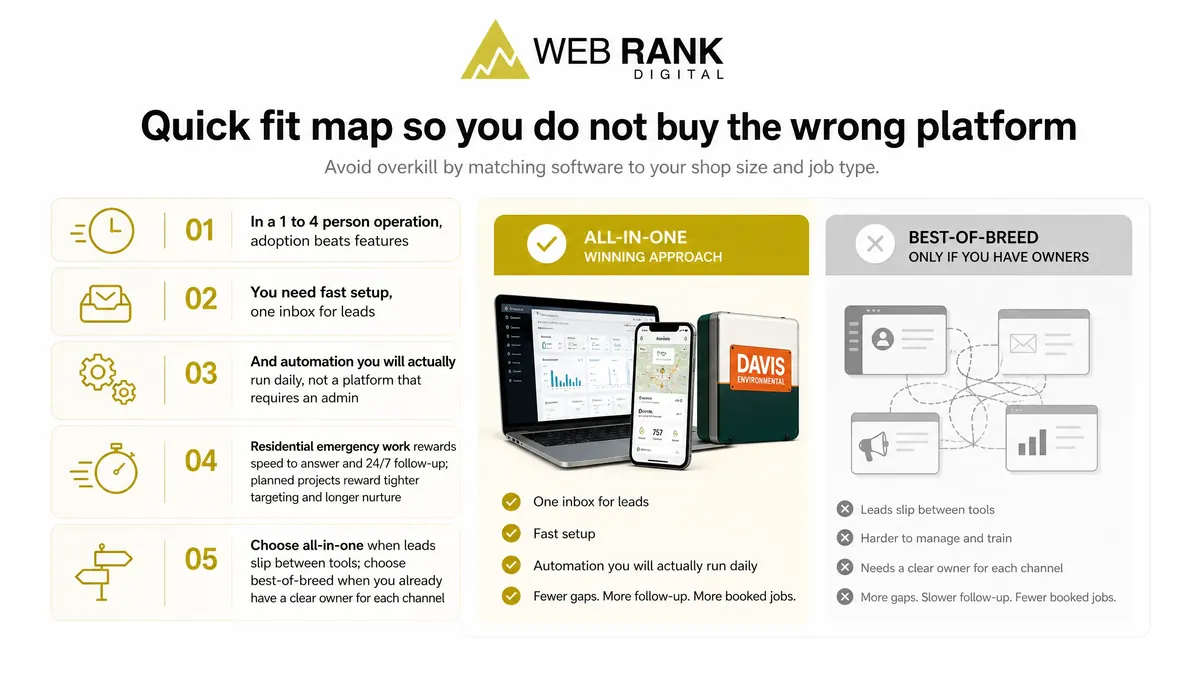
Avoid overkill by matching software to your shop size and job type. In a 1 to 4 person operation, adoption beats features: you need fast setup, one inbox for leads, and automation you will actually run daily, not a platform that requires an admin. Residential emergency work rewards speed to answer and 24/7 follow-up; planned projects reward tighter targeting and longer nurture.
Choose all-in-one when leads slip between tools; choose best-of-breed when you already have a clear owner for each channel.
1. Web Rank Digital National Customer Accelerator Electrician Module
Web Rank Digital’s National Customer Accelerator Electrician Module is built for one outcome: fewer lost leads caused by disconnected tools. Our competitor gap detection algorithm ingests your service territory and top local competitors, then flags where demand exists but their visibility and targeting break down, so your offers and pages can intercept high-intent searches.
From there, the Automated Lead Funnel System runs 24-7 capture and follow-up so calls, forms, and messages do not sit unworked after hours. You keep context attached to every inquiry, route by residential vs commercial intent, and push consistent next steps until the lead books. Book a demo to run a gap scan on your primary service area.
2. Housecall Pro
Housecall Pro is built for service business workflows first, which is why many electricians like it for running the day, not necessarily for generating new demand. It covers the core loop well: estimates, invoicing, and customer communications are native, so you can quote faster, collect payment, and keep homeowners updated without stitching together multiple tools. Where it can fall short for acquisition is that marketing features and add-ons vary by plan tier, so you may still need a dedicated customer acquisition layer to consistently drive new leads into that workflow.
3. HubSpot
HubSpot is best when you need complex lifecycle marketing, not just basic follow-up. If your electrical business runs multiple audiences and long sales cycles, it can unify email automation, deal stages, and attribution-level reporting so you can see which sequences actually create booked work. The trade-off is real: meaningful value requires admin time for data cleanup, pipeline design, permissions, and automation governance.
For a 1 to 4 person shop, it often becomes shelfware unless one owner or ops lead commits to ongoing configuration.
4. Thryv
Thryv can be “enough” when you want one all-in-one suite to cover the basics without stitching tools together. For a local electrical contractor, it bundles CRM, listings management, review management, and basic automation, which helps you stay consistent on citations and keep review requests moving with minimal setup.
The tradeoff shows up when you need advanced attribution. You may outgrow Thryv’s reporting once you are trying to tie specific jobs to specific keywords, campaigns, and call paths, or when you need deeper multi-touch visibility to optimize spend confidently.
5. Local Falcon
Local Falcon is measurement, not a fix. You run local map rank grid scans to see where your Google Business Profile shows up across real map pins, instead of guessing from your office. For electricians, that lets you benchmark service area visibility street by street, spot neighborhoods where competitors outrank you, and validate whether recent changes moved the needle.
Just do not confuse visibility with revenue: you still need a separate capture and follow-up system, or those map impressions will not turn into booked jobs.
6. ServiceTitan
ServiceTitan is built for scaling service companies, so you typically get the most value when you are running 10+ trucks and need tighter control of dispatch, booking, and the full job lifecycle. Where it can outperform for larger electrical contractors is visibility: strong reporting and built-in call tracking let you tie demand to booked work with call attribution tracking, not gut feel. The overkill risk is real for small teams.
Pricing is quote-based, user-reported at $245-$500 per tech per month, with reported implementation costs of $5,000-$50,000+ and a longer onboarding and learning curve.
7. Jobber
Jobber is a practical fit when your priority is moving electrician leads from “request” to “approved” with clean, fast quoting. The quoting workflow is its strength: you can build and send quotes, keep client communication organized, and reduce back-and-forth that slows close rates. For small teams, the follow-ups and reminders are simple and effective, helping you stay on top of unanswered quotes without building complex automation.
Where Jobber is limited, by design, is acquisition intelligence: it is not built for competitor gap analysis or market-level visibility benchmarking, so it will not tell you where local competitors are winning demand.
8. GoHighLevel
GoHighLevel gets recommended to electricians because you can build a full lead funnel and run SMS automations from one place, which helps you follow up fast on estimate requests and missed calls. It is also built for an agency-style, multi-account structure: even on Starter you can manage up to 3 sub-accounts, and higher tiers allow unlimited, which matters if you run multiple brands or locations. The tradeoff is DIY setup time and ongoing maintenance.
Without a clear electrician funnel map, you will spend weeks stitching pages, triggers, and messaging together, then debugging usage fees, phone numbers, and workflow drift.
9. Podium
Podium is strongest when your biggest leak is slow lead response. It is built around text-first workflows, so you can route new inquiries into a unified inbox and reply fast, instead of letting web forms and missed calls sit. It also supports review generation at scale by automating review requests after a job, helping you build volume and velocity across major platforms.
The tradeoff: Podium is not a full acquisition platform, so it will not replace your lead sources or competitor-driven demand capture.
10. CallRail
CallRail closes the ROI blind spot between your ads, your phone, and the job you actually book. You can deploy dedicated tracking numbers by channel, record calls for quality and dispute resolution, and see which campaigns drove real conversations instead of vague “phone rang” reporting.
It also extends beyond calls: with call attribution tracking, you can tie both calls and form submissions back to the source that generated them, so you stop debating whether Google Ads, Local Service Ads, or organic search is paying off.
The constraint is the handoff. If call outcomes never make it into your CRM, attribution dies at “lead.” Build a closed loop: push call details, tags, and dispositions into your pipeline so booked jobs and revenue reconcile to the original source.
11. Google Ads
Google Ads is your fastest path to capture high-intent electrician leads, especially emergencies where the customer is searching right now and will call the first credible option. You control risk by tightening campaigns to the exact service areas you can actually cover, using location targeting and budgets per territory so you do not pay for clicks outside your radius. The channel only performs when you pair it with purpose-built landing pages and rigorous tracking, including call attribution tracking, so you can tie keywords and ads to booked jobs and shut off waste quickly.
12. Google Business Profile
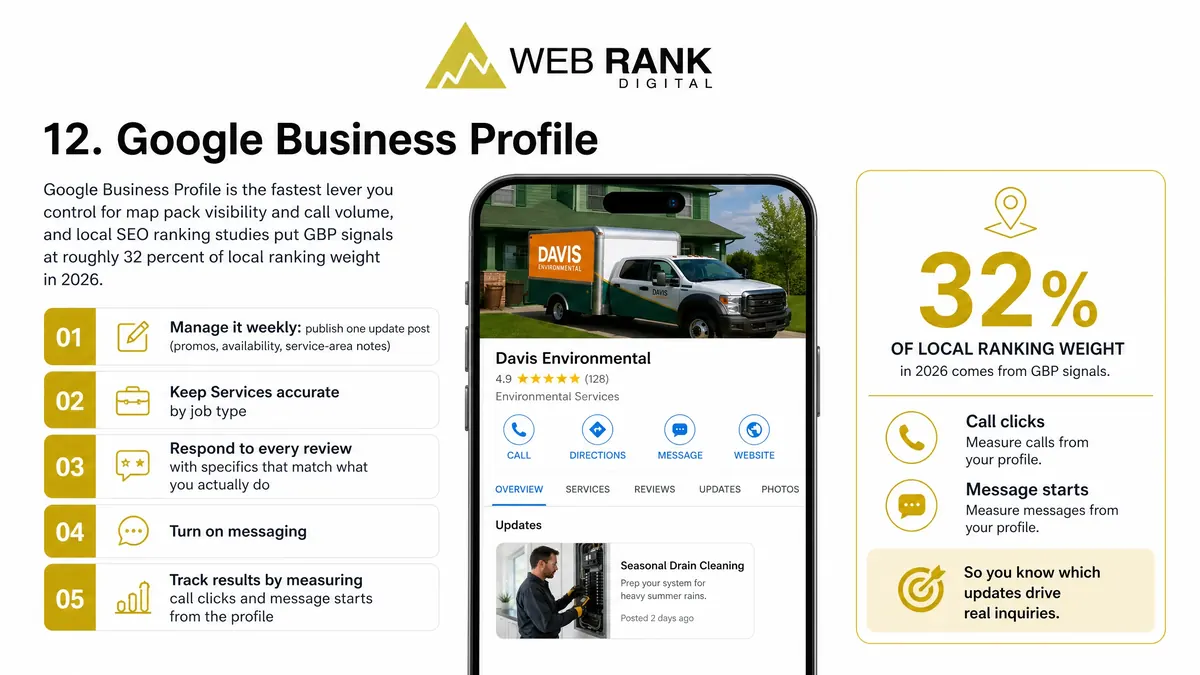
Google Business Profile is the fastest lever you control for map pack visibility and call volume, and local SEO ranking studies put GBP signals at roughly 32 percent of local ranking weight in 2026. Manage it weekly: publish one update post (promos, availability, service-area notes), keep Services accurate by job type, and respond to every review with specifics that match what you actually do. Turn on messaging and track results by measuring call clicks and message starts from the profile so you know which updates drive real inquiries.
13. Google Analytics 4
Google Analytics 4 is your baseline for knowing which website actions create electrician leads and which campaigns actually drove them. You set up conversion events like form submissions, click-to-call button clicks, quote requests, and key page views, then evaluate performance by campaign and channel using consistent UTM tagging. The catch: GA4 setup is easy to get wrong without expertise, especially with event definitions, cross-domain tracking, and filtering noise.
It is necessary, but not sufficient unless you pair it with call tracking and CRM linkage to confirm booked jobs.
14. Meta Ads Manager
Meta Ads Manager is a strong pipeline builder for planned electrical work because you can retarget people who already visited your estimate page or opened a quote follow-up. Use retargeting to stay in front of “thinking about it” homeowners and GCs until they book. For capture, Meta lead forms reduce friction on mobile, while landing pages usually qualify better (scope, service area, timeline) and feed cleaner data into your follow-up automation.
Meta is weaker for emergency intent; urgent calls typically start on search, not social.
15. Mailchimp
Mailchimp is a lightweight way to keep estimates from going cold and to reactivate past customers without building a full marketing stack. Set up a short nurture sequence after an estimate goes out, then a separate reactivation cadence for customers who have not booked in 6 to 12 months. Start with templates, swap in your service categories, and keep automations simple: one reminder, one proof point, one clear next step.
The tradeoff is attribution. You will see opens and clicks, but sales pipeline tracking and closed-won reporting are limited unless you bolt on other systems. List hygiene matters: tag by service type, remove hard bounces, and regularly suppress inactive addresses.
16. ActiveCampaign
ActiveCampaign earns its keep when you need real segmentation and lifecycle automation, not just newsletters. You can tag by service type, job size, and behavior, then branch follow-up based on opens, clicks, and replies, which is where it can outperform lighter tools.
For bid-driven work, it supports multi-step nurture that keeps you present without chasing: quote sent, reminder, proof points, scope clarifier, and reactivation if the prospect goes quiet.
The tradeoff is setup overhead. Small teams stall here because messy lead intake creates bad tags and broken automations. Clean forms, consistent fields, and one owner for upkeep are required.
17. Birdeye
Birdeye is built for review-heavy, multi-location operators where you need centralized control without losing location-level accountability. You can monitor and respond to reviews across locations from one place, standardize reply workflows, and keep governance tight as your footprint grows. It also competes well on messaging: the unified inbox helps you manage conversations across channels so customers do not fall through cracks.
The trade-off is cost: pricing starts around $299 per location per month, so it fits best when your review volume and brand risk justify the spend.
18. NiceJob
NiceJob is a focused point solution when you need consistent review proof fast, not a full marketing suite. After each completed job, it can automatically send review invites by email and SMS, helping you capture feedback while the service experience is still fresh. Setup is straightforward for a solo electrician or small shop: connect your key review profiles and trigger invites from your completed-job list.
The tradeoff is limited broader marketing analytics, so you should not expect deep channel reporting or funnel attribution.
19. BrightLocal
BrightLocal is strong for electricians who need clear visibility benchmarks: local rank tracking (including geo-based views) plus audits that flag gaps in your Google Business Profile and local presence. It also gives you citation management options, from monitoring existing listings to building new citations when your NAP consistency is off. The limitation is operational: BrightLocal will not automate lead capture or lead follow-up, so you still need execution capacity to turn better rankings and cleaner listings into booked calls.
20. SEMrush
SEMrush is built for deep keyword and competitor research, not electrician-workflow execution, so it can be overkill if you will not commit time weekly. Where it shines is mapping what competitors rank for, spotting content gaps, and estimating keyword difficulty so you can plan pages that actually have a chance to win.
You also get site audits for technical issues and solid backlink research to see who is linking to competing sites and where your authority is thin. The tradeoff is real: it is a powerful suite with a learning curve, and a small team often underuses it unless one person owns it for a few hours per week.
21. Ahrefs
Ahrefs is strongest when your priority is link intelligence: you can audit your backlink profile, find which pages earn links, and run content gap analysis to see topics competitors cover that you do not. It also makes competitive domain comparisons straightforward, so you can benchmark authority signals and identify which sites consistently outrank you in local organic results. The limitation is simple: Ahrefs does not capture leads or run follow-up.
You still need a conversion system to turn that research into booked electrician jobs.
22. Unbounce
Unbounce is built for paid traffic, which matters when you are buying clicks for electrician leads and cannot afford to send emergency searchers to a generic “services” page. We set up separate pages so message match stays tight: emergency repair emphasizes immediate availability and direct phone-first action, while planned work (panel upgrades, EV charger installs) supports estimate requests and scheduling.
Conversion gains come from simple A/B tests on one variable at a time (headline, offer, form length, primary CTA). Pair it with call tracking and a follow-up workflow, or you will optimize the page while still losing jobs after the click.
23. Leadpages
Leadpages is a solid pick when you need a landing page live fast and you do not want your launch blocked by design decisions. You start with conversion-focused templates, swap in your offer, and publish quickly, which works well for small electrical shops running a simple service-area promo or seasonal campaign. The built-in lead capture forms cover the basics: name, email, phone, and a straightforward inquiry.
The trade-off is flexibility. You can make clean pages, but deeper experimentation and highly customized flows are more limited once you want advanced testing and segmentation.
24. Calendly
Calendly helps you convert “request an estimate” traffic into booked time slots for residential estimates and commercial walkthroughs, without phone tag. The win is fewer back-and-forth texts, plus automated reminders that cut no-shows by confirming time, location, and who will be onsite. The risk is lead leakage: if Calendly is not connected to your lead funnel automation, booked and unbooked requests can sit in a disconnected tool.
You need qualification and routing rules so commercial requests go to the right calendar, and urgent work gets prioritized.
25. Zapier
Zapier is the glue that connects your web forms, inbox, and CRM so a new inquiry becomes a contact and a follow-up task without manual copy-paste. It is useful, but it is also where brittle workflows hide: automations can fail silently after an app update, a credential change, or a field mismatch, and you only notice when leads stop showing up. Put a monthly audit on the calendar to verify every Zap still fires end-to-end, and you will prevent quiet lead loss.
How to choose in 10 minutes and launch this week
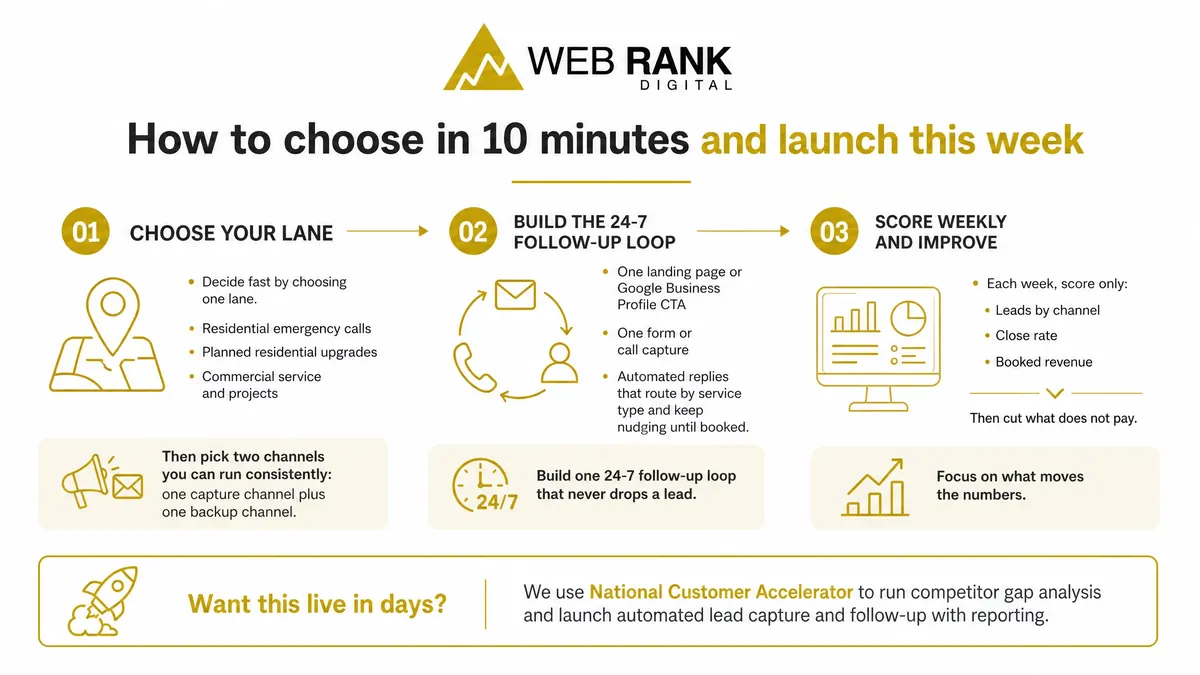
Decide fast by choosing one lane and two channels you can run consistently: your lane (residential emergency calls or planned residential upgrades, or commercial service and projects), then one capture channel plus one backup channel. Build one 24-7 follow-up loop that never drops a lead: one landing page or Google Business Profile CTA, one form or call capture, and automated replies that route by service type and keep nudging until booked. Each week, score only: leads by channel, close rate, and booked revenue, then cut what does not pay.
If you want this live in days, we use National Customer Accelerator to run competitor gap analysis and launch automated lead capture and follow-up with reporting.
Turn your next lead into a booked job, not a missed call
If you want more booked jobs, start by finding where your local competitors are winning and where you are leaking leads today. We do that in one system.
With the National Customer Accelerator Electrician Module, we run a competitor gap analysis in your top service area, then deploy an Automated Lead Funnel System that captures and follows up 24/7. You also get an Analytics and Reporting Dashboard that makes the weekly scoreboard simple, so you can see leads, close rate, and revenue by channel without guessing.
Book a demo built for electricians. Ask us for the Electrician Module quote and your onboarding timeline. Then request a competitor gap detection run so you can launch your 24/7 automated lead capture funnel with an account manager.
Frequently Asked Questions
How does the platform help electricians compete against larger contractors?
We use competitor gap analysis to show you where larger contractors are capturing demand and where they are leaving openings in specific service areas and job types. Then we put an automated lead capture and follow-up loop in place so you respond faster and convert more of the high-intent calls and form fills you are already missing.
Can this platform handle both residential and commercial electrical services?
Yes. We segment campaigns and funnels by service type so you can prioritize fast-moving residential emergency calls while also building a separate path for higher-value commercial project targeting, with messaging tailored to each.
How is ROI measured with this software?
You track performance in the Analytics and Reporting Dashboard, including lead volume, conversion rates, job value, and revenue by channel. That lets you make weekly decisions based on what is producing booked jobs, not what feels busy.