The best local SEO and lead generation platform under $500 is the one that proves lead quality with real actions, like phone calls, direction requests, and website clicks, and then helps you follow up fast.
Here’s what matters most when you are choosing under $500:
- Measure success by calls, direction requests, and website clicks, not vanity ranking reports.
- Run a competitor and geo-targeted keyword gap audit before you pick any platform.
- Compare platform types by follow-up reliability, not just local search visibility.
- Demand a clear time to first qualified lead, then monitor results week by week.
- Watch for hidden costs like onboarding work and integration effort that inflate your real spend.
At Web Rank Digital, we built our National Customer Accelerator around closed-loop local lead generation: Google Business Profile optimization, automated customer funnels, and engagement-metric reporting that shows what turned into calls, directions, and clicks. Start with the only question that cuts through the noise: can the platform show lead proof in your market, not just activity. That is why we begin with Web Rank Digital National Customer Accelerator and the engagement metrics that matter when you are trying to buy predictable local demand under $500.
1. Web Rank Digital National Customer Accelerator
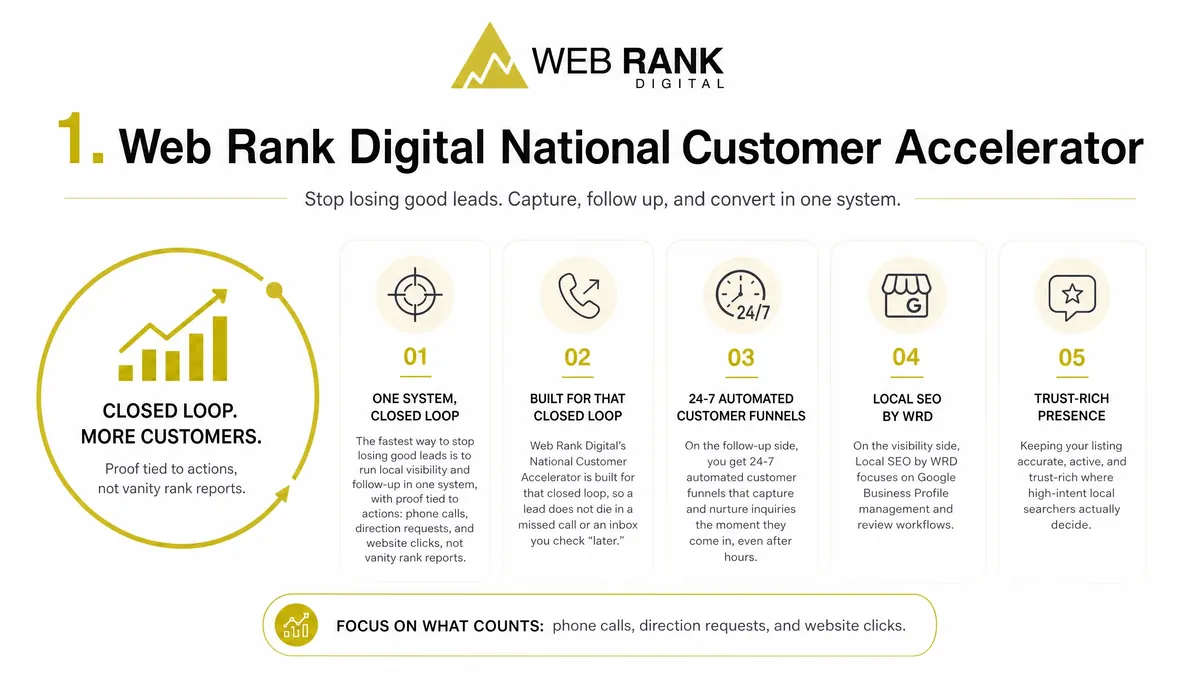
The fastest way to stop losing good leads is to run local visibility and follow-up in one system, with proof tied to actions: phone calls, direction requests, and website clicks, not vanity rank reports. Web Rank Digital’s National Customer Accelerator is built for that closed loop, so a lead does not die in a missed call or an inbox you check “later.”
On the follow-up side, you get 24-7 automated customer funnels that capture and nurture inquiries the moment they come in, even after hours.
On the visibility side, Local SEO by WRD focuses on Google Business Profile management and review workflows, keeping your listing accurate, active, and trust-rich where high-intent local searchers actually decide.
2. BrightLocal
BrightLocal is a strong under-$500 pick when your priority is cleaning up listings, running local SEO audits, and producing client-ready reporting you can defend in a review call. It fits best in agency-style workflows where you need repeatable citation management, rank tracking, and white-label reports across multiple clients or locations. It is one of the most established agency-focused local SEO platforms, used by 7,500+ agencies across the USA, Canada, Australia, and the UK.
The gap is conversion: BrightLocal will not run your lead funnels or follow-up, so you still need a separate system to capture, nurture, and close leads.
3. Local Falcon
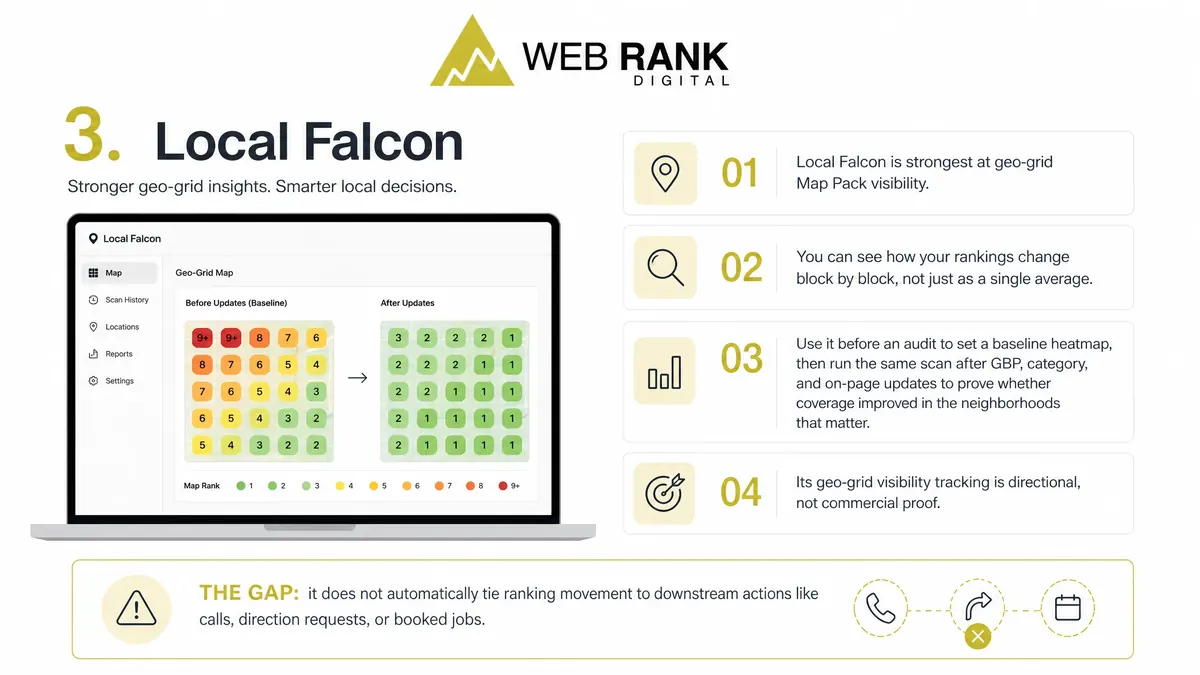
Local Falcon is strongest at geo-grid Map Pack visibility: you can see how your rankings change block by block, not just as a single average. Use it before an audit to set a baseline heatmap, then run the same scan after GBP, category, and on-page updates to prove whether coverage improved in the neighborhoods that matter. Its geo-grid visibility tracking is directional, not commercial proof.
The gap: it does not automatically tie ranking movement to downstream actions like calls, direction requests, or booked jobs.
4. Orbit AI
Orbit AI is a budget-friendly accelerator because it helps you publish local SEO content fast and at scale. That speed only matters if the content pushes measurable Google Business Profile outcomes, not just more pages.
Where Orbit AI tends to pay off is repetitive, intent-heavy assets like FAQs (pricing, timing, service area, “near me” questions) and location-specific service pages that support Map Pack visibility and website clicks.
The risk is shipping content without conversion tracking. If you cannot tie each page to calls, direction requests, or form fills, you are producing activity, not lead quality proof.
5. Google Local Services Ads
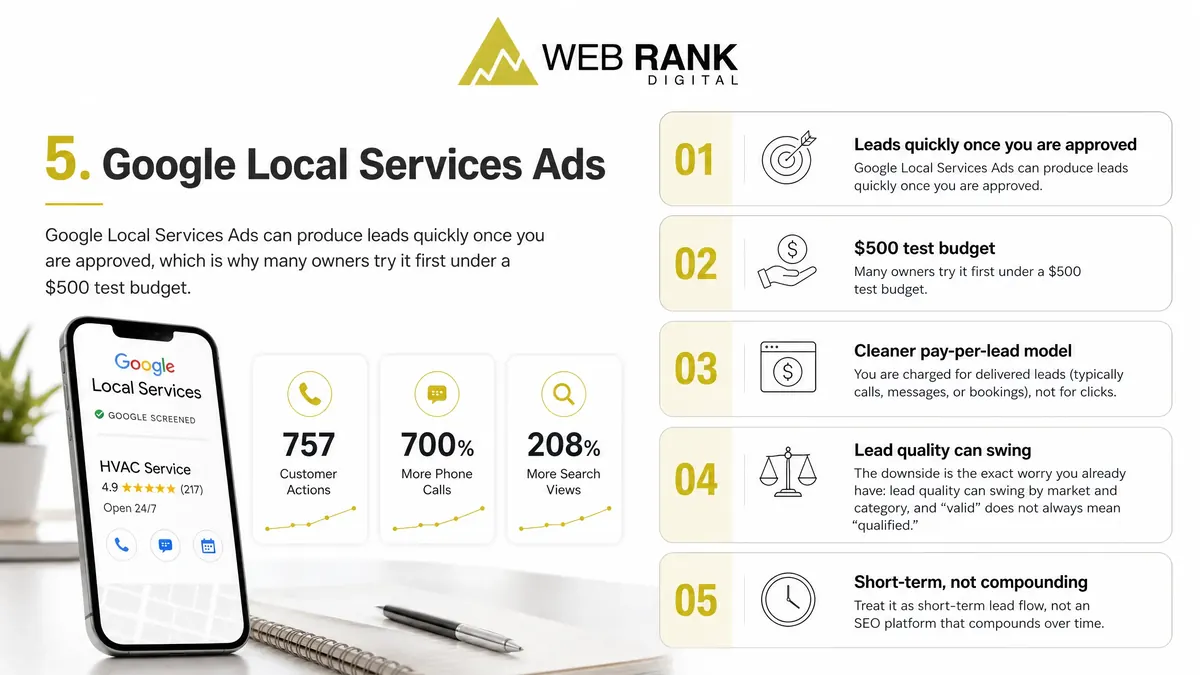
Google Local Services Ads can produce leads quickly once you are approved, which is why many owners try it first under a $500 test budget. It is one of the cleaner pay-per-lead advertising models: you are charged for delivered leads (typically calls, messages, or bookings), not for clicks. The downside is the exact worry you already have: lead quality can swing by market and category, and “valid” does not always mean “qualified,” so you can still pay for price-shoppers or mismatched requests.
Treat it as short-term lead flow, not an SEO platform that compounds over time.
6. Yelp for Business
Yelp can deliver qualified demand because it is an active marketplace, not passive browsing. Yelp’s buyer intent research says nearly 90% of users make a purchase within a week of visiting Yelp, which is why it can work in dense metro categories where buyers compare multiple providers fast.
Protect ROI by tightening your service area to where you will actually dispatch, and by treating attribution as a first-class problem. Lead disputes happen when calls are missed, routed wrong, or logged inconsistently. Use a dedicated tracking number and rigid “qualified lead” rules so you can reconcile what Yelp sent versus what your team could convert.
7. Angi Leads
Angi Leads can deliver immediate lead flow, which is why it can fit a tight budget when you need jobs on the board now. The tradeoff is lead quality uncertainty: prospects often contact multiple contractors at once, so slow response times get punished.
This channel performs best when you have high-capacity dispatch and a tight intake script that qualifies fast, prices confidently, and books the visit on the first call.
To avoid paying for tire-kickers, you must track close rate by source, not just lead volume, and cut any category or zip where your win rate stays low.
8. Thumbtack
Thumbtack is a classic pay-per-lead channel where you can uncover smaller, in-between jobs you will not always see in search, like minor repairs or single-room work. It performs best when your service is easy to price fast, because customers often request multiple quotes in a short window. The real risk is not the platform, it is your response time.
If you reply hours later, you usually lose the bid to the first credible pro who answers with a clear price range and next available slot.
9. ServiceTitan Marketing Pro
ServiceTitan Marketing Pro is built for home service operators who want one view of performance, tying marketing activity to what happens in the field and back to booked revenue. Its biggest strength is unified ops plus marketing reporting, which helps mature teams spot which channels drive the right jobs, not just leads. The constraint is budget: between per-technician licensing, the Marketing Pro add-on, and implementation, many businesses targeting an under-$500 stack will treat it as a future upgrade path once headcount and volume justify the lift.
10. Birdeye
Birdeye is a reputation engine, not a full local SEO and lead generation platform, but it can still lift Map Pack conversion by helping you earn more reviews and respond faster at scale. Its core strength is automated review generation plus streamlined monitoring and replies, so your Google Business Profile trust signals do not drift. It fits best when you manage multiple locations and need consistent oversight across listings.
The gap is that visibility and customer funnels are not automatic, so you still need a system to turn clicks into calls and follow-up.
Stop Paying for Rankings.
Start Tracking Qualified Actions.
If local lead gen has felt like a scam, it usually comes down to two issues: you are paying for unqualified leads, or you are losing good leads to slow, inconsistent follow-up. We built the National Customer Accelerator to remove both problems by tying local search visibility to real engagement metrics you can audit, including phone calls, direction requests, and website clicks.
Here is the next step. Book a National Customer Accelerator demo with us at Web Rank Digital and request a heatmap plus competitor analysis for your market. We will benchmark your current visibility, define your engagement-metric goals, then deploy Google Business Profile Optimization and Automated Customer Funnels with an account manager guiding onboarding and optimization.
Frequently Asked Questions
How much should I pay for local SEO?
You should pay based on what you can measure and improve: calls, direction requests, website clicks, and close rate by source. If a provider cannot tell you what it will take to reach your first qualified lead and how follow-up is handled, the lowest price is still high risk.
What are some good local SEO platforms?
Look for platforms that combine Google Business Profile work, geo-targeted keyword tracking, and reporting that proves real actions, not just rankings. The strongest options also address what happens after the lead arrives with consistent follow-up and clear attribution.
How long does it take to see results from local SEO?
Most local SEO campaigns show measurable movement within 30 to 90 days, with more meaningful gains building over 6 to 12 months. The key is to track early leading indicators like calls and direction requests, not just impressions.
What is the difference between local SEO and regular SEO?
Local SEO targets geo-specific intent and prioritizes visibility in Google Maps and the Local 3-Pack, supported by Google Business Profile optimization, local directories, and service area relevance. Regular SEO focuses more on broader, non-location queries and is not anchored to Maps actions.
What metrics should I track for local SEO success?
Track phone calls, direction requests, website clicks, and how those actions convert into booked jobs or signed cases. Use ranking and top-3 coverage as supporting context, but let engagement and conversion tell you whether lead quality is improving.