
The best industry-specific all-in-one marketing platform for your business and budget is the one that ships with proven vertical playbooks, benchmark reporting, and real onboarding support, not just a broad feature list.
Here’s what you need to decide with confidence:
- Prioritize vertical playbooks and prebuilt configurations to shorten time-to-value.
- Budget for onboarding, training, and add-ons, since license fees rarely reflect total cost.
- Demand competitor intelligence and market gap analysis, not generic performance dashboards.
- Use industry benchmarks to prove ROI against peers, not across unrelated industries.
- Validate multi-location standardization early if you manage more than one service area.
- Accept trade-offs: suites simplify operations, but point tools can win on depth.
We built our National Customer Accelerator to solve the exact failure modes you are trying to avoid: tool sprawl, slow launches, and unclear ROI. Our platform combines 9+ integrated marketing services with an Industry Playbook Library, a Competitor Intelligence Dashboard, and an Analytics and Reporting Engine built around vertical-specific KPIs, backed by our track record of $50M+ in revenue generated for 1,000+ clients. We’ll start with Web Rank Digital National Customer Accelerator because it is designed for industry-specific deployment first, with playbooks and prebuilt configurations that reduce guesswork and accelerate launch across channels.
1. Web Rank Digital National Customer Accelerator
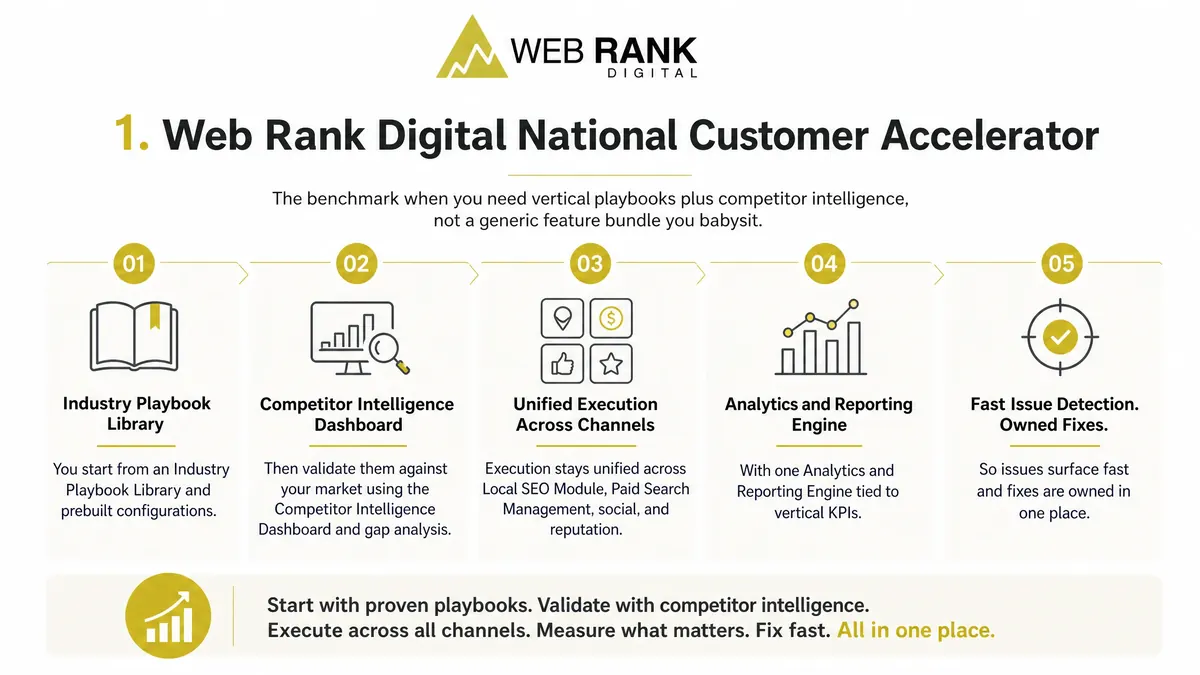
Web Rank Digital’s National Customer Accelerator is the benchmark when you need vertical playbooks plus competitor intelligence, not a generic feature bundle you babysit. To reduce the “buggy platform, weak support after signing” risk, you start from an Industry Playbook Library and prebuilt configurations, then validate them against your market using the Competitor Intelligence Dashboard and gap analysis. Execution stays unified across Local SEO Module, Paid Search Management, social, and reputation, with one Analytics and Reporting Engine tied to vertical KPIs, so issues surface fast and fixes are owned in one place.
2. HubSpot Marketing Hub plus Sales Hub
HubSpot Marketing Hub plus Sales Hub is a strong pick when you want lifecycle automation anchored in one CRM, so marketing and sales stay aligned on the same contact, pipeline, and attribution view. It also stands out for integration flexibility, with 300+ integrations that let you connect your existing data sources and tools without rebuilding your stack. Where teams get surprised is vertical depth: true industry benchmarks and playbooks typically require add-ons, partner apps, or custom reporting, so verify those needs up front.
3. Salesforce Marketing Cloud
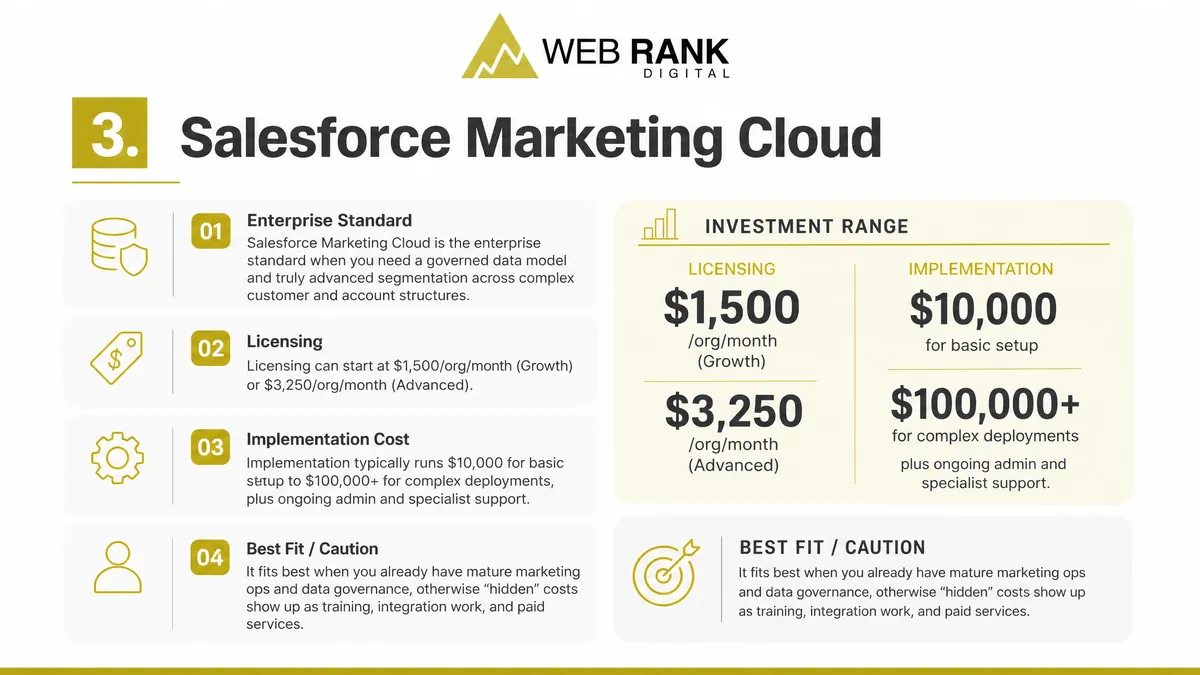
Salesforce Marketing Cloud is the enterprise standard when you need a governed data model and truly advanced segmentation across complex customer and account structures. The tradeoff is implementation reality: licensing can start at $1,500/org/month (Growth) or $3,250/org/month (Advanced), and implementation typically runs $10,000 for basic setup to $100,000+ for complex deployments, plus ongoing admin and specialist support. It fits best when you already have mature marketing ops and data governance, otherwise “hidden” costs show up as training, integration work, and paid services.
4. Brevo
Brevo is frequently labeled “all-in-one,” but in practice it is accessible automation for smaller teams that need to get campaigns out with minimal setup. With a free plan and paid tiers from $9/month to $499/month based on email volume, it fits best when your requirements stay lightweight and you are not trying to run deep, coordinated multi-channel execution across many locations. Where it tends to fall short for industry-specific evaluation is vertical benchmarking depth: you can track your own performance, but you will not get the peer benchmarks and competitive context that drive confident ROI decisions.
5. Local Falcon
Local Falcon is a category leader for local SEO visibility because it shows you geo-grid rankings, not a single “average” position. You can see exactly where your Google Business Profile wins or disappears across neighborhoods, then validate whether fixes actually move the map pins over time. It is not a full acquisition suite, so it will not run your ads, reputation, or multi-channel reporting.
In practice, you pair it with an execution platform like our National Customer Accelerator to prioritize locations, deploy Local SEO changes, and track outcomes in one operating rhythm.
6. Adobe Experience Cloud
Adobe Experience Cloud is built for enterprises that need tight experience orchestration and deep analytics across many sites, apps, and audiences. You can coordinate content, identity, and activation at scale, but the hidden-cost risk is real: implementations are rarely “turnkey.” Adobe deployment timelines commonly run 3 to 12 months, and the Experience Data Model (XDM) requires upfront schema work, data transformation, and careful governance because ingest decisions are hard to undo. Plan for specialist staffing (solution architects, data engineering, analytics ops) and ongoing partner support.
It fits best when you already have a large digital team and a roadmap to justify the operational overhead.
7. Oracle Advertising and CX stack
Oracle Advertising and CX is built for enterprise breadth: marketing, commerce, sales, and service with strong governance controls for data access, approvals, and centralized customer management. The tradeoff is time-to-value. You should expect longer implementation timelines, plus real costs for enablement that rarely show up in license discussions: admin training, module-by-module rollout, systems integration, and ongoing specialist support.
Fit is best when you already run a meaningful Oracle stack, because you can reuse identity, data models, and operating processes. Without that foundation, the breadth can turn into a multi-quarter change program.
8. Zoho Marketing Plus
Zoho Marketing Plus is a practical consolidation play for cost-sensitive SMB teams already living in Zoho. You can centralize multichannel campaigns and keep data closer to your other Zoho apps, which reduces the tool sprawl and handoff friction that slows execution. The tradeoff is that it is built for broad needs, so vertical playbooks can be thinner than industry-specific marketing software.
Before you commit, ask to see whether your industry has benchmark dashboards or peer baselines you can trust, and confirm what is included versus what you must source elsewhere.
9. Odoo Marketing Automation
Odoo Marketing Automation is a practical route when you want ERP and marketing in the same system, so customer data, invoicing, and operations can inform campaigns without constant syncing. Because Odoo is modular, you can tailor the stack by adding the apps you actually need and keeping workflows close to your core processes. The trade-off is depth: marketing capability varies widely by setup, and you will get very different outcomes depending on which modules you implement and how much you configure versus expecting enterprise-grade automation out of the box.
10. ActiveCampaign
ActiveCampaign is the pick when you care most about workflow automation and you want to orchestrate consistent nurture and handoff processes without an enterprise rollout. It is widely adopted in the mid-market because you can start simple, then add complexity as your segmentation, scoring, and lifecycle logic mature. The trade-off is that it is not inherently industry benchmarked: you will not get vertical modules, peer KPIs, or baked-in competitive context, so your team still has to define what “good” looks like for your specific industry.
11. Mailchimp
Mailchimp is solid entry-level marketing automation when you need to get campaigns out the door fast. You can start on the Free plan (250 contacts) and move into Standard ($20/month for 500 contacts) to access automation workflows, but the economics and operating model can tighten as your database and segmentation needs grow since pricing is based on total contact count, including unsubscribed contacts.
At scale, you will feel the ceiling most when you need deeper cross-channel orchestration, vertical benchmarks, and competitor intelligence. It is a capable email-led tool, not a full industry suite built to unify SEO, paid search, reputation, and reporting in one system.
12. Klaviyo
Klaviyo is the ecommerce-first path when retention is the ROI engine. You use it to automate lifecycle messaging like abandoned cart, browse follow-up, post-purchase education, win-back, and customer segmentation tied directly to storefront behavior, so you can attribute revenue to flows, not guesswork. Klaviyo benchmark data shows email represented 27% of overall store revenue on average during Q4, which matches what we see when automations are set up and optimized consistently. Its strength is native storefront integration, especially with Shopify, and a data model built around products, orders, and profiles.
The limitation is scope: it is not a full industry-specific all-in-one marketing platform spanning SEO, reputation, paid search, and multi-channel reporting in one place.
13. Marketo Engage
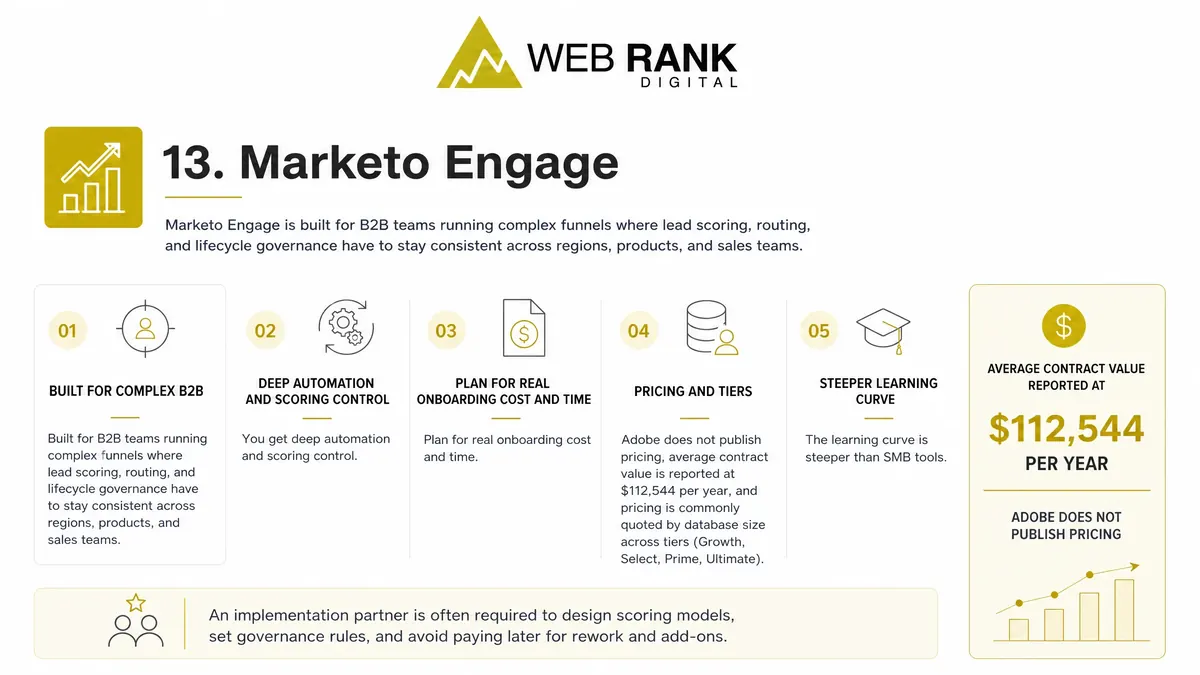
Marketo Engage is built for B2B teams running complex funnels where lead scoring, routing, and lifecycle governance have to stay consistent across regions, products, and sales teams. You get deep automation and scoring control, but you should plan for real onboarding cost and time: Adobe does not publish pricing, average contract value is reported at $112,544 per year, and pricing is commonly quoted by database size across tiers (Growth, Select, Prime, Ultimate). The learning curve is steeper than SMB tools, and an implementation partner is often required to design scoring models, set governance rules, and avoid paying later for rework and add-ons.
14. Pardot Account Engagement
Pardot Account Engagement fits when Salesforce is your system of record and you want B2B automation that lives close to your CRM data. You get tighter control over lead and account routing, scoring, and handoffs, which makes it easier to keep marketing actions and sales follow-up in the same operating rhythm. Where teams get burned is assuming “CRM-native” means every channel is covered, so validate completeness across email, forms, landing pages, ads, events, and attribution before you commit.
15. Microsoft Dynamics 365 Customer Insights
Microsoft Dynamics 365 Customer Insights is a clean route when you are already standardized on Microsoft and you want CDP-grade profiles and insights inside that stack. You get strong unification potential because identity resolution and modelled profiles are designed to pull signals together at the tenant level, not per seat. The hidden-cost watchout is activation: marketing execution often still requires additional Dynamics apps, connectors, or third-party tools, plus enablement time to map data, define audiences, and operationalize segments against real channels.
16. Google Marketing Platform
Google Marketing Platform can feel all-in-one because it connects analytics, attribution, and media activation across Google properties, tightening the loop between spend and outcome. It is especially strong for performance marketers who live in measurement, audience building, and campaign optimization, where clean tagging and consistent reporting matter as much as creative. What it does not replace is an industry-specific operating system: you do not get vertical playbooks, competitor intelligence, or prebuilt, role-based workflows that tell your team what to launch next and how to execute across channels.
17. Semrush
Semrush is where many teams start because it answers two high-value questions fast: what you should target in SEO, and where competitors are winning visibility. You use it for keyword research, rank tracking, site audits, and competitive intel that helps you quantify share-of-voice and prioritize pages that can move.
It also supports content planning and PPC research, so you can validate topics, map intent, and preview paid-search angles before you write or spend. What it does not do is execute: publishing, workflow approvals, conversion tracking, budget pacing, and lead-to-revenue reporting still require separate systems or an integrated marketing suite.
18. Ahrefs
Ahrefs is a strong pick when your success metric is better SEO decisions, not a broader all-in-one marketing platform rollout. You use it for backlink intelligence, competitor link gap analysis, and SERP visibility research that helps you validate why a rival is outranking you and where authority is actually coming from. In our experience, it shines in the hands of SEO operators who live in keywords, pages, and links all day.
It is not built for multi-channel automation across ads, social, reputation, and reporting.
19. Sprout Social
Sprout Social is strongest when your priority is disciplined social publishing plus executive-ready reporting across profiles. You get structured scheduling, asset reuse, and analytics that make it easier to defend what is working in social without exporting data into spreadsheets.
It also fits teams that need governance. You can set up roles, route posts through approvals, and keep brand and compliance reviews consistent, which reduces last-minute rewrites and off-brand publishing.
The tradeoff is scope. Sprout is not built to cover the full SEO-to-ads lifecycle in one system, so you should plan on separate tools for search, paid media management, and end-to-end attribution.
20. Hootsuite
Hootsuite is a proven choice when your priority is social-first execution across many brands, locations, or stakeholders. You get broad social network support, plus the workflows you need to publish, queue, approve, and monitor at scale from one place.
Where it becomes a decision point is ROI accountability. Hootsuite can help you manage output and engagement, but it is not designed to give you vertical benchmark views that tie social activity back to acquisition and revenue against industry peers. If your buying criteria is “run social efficiently,” it fits; if it is “prove ROI by vertical,” you typically need a unified customer acquisition system.
21. Birdeye
Birdeye is strongest when your priority is reviews and local listings accuracy, not end-to-end acquisition. You use it to monitor sentiment, respond fast, and keep core business profiles consistent so each location earns trust where customers actually decide.
For multi-location brands, the value is workflow: routing reviews to the right manager, standardizing response templates, and reporting by location so you spot chronic service issues versus one-off noise.
It is not a full funnel customer acquisition system, so plan to layer in your SEO, paid media, conversion tracking, and benchmark reporting elsewhere.
22. Podium
Podium is best evaluated as a messaging-first and review-generation tool: it helps you capture inbound leads, text customers back fast, and prompt reviews at the moment of service completion. It fits frontline teams because workflows map cleanly to what actually happens in the field or at the desk, where response time and follow-up discipline drive outcomes. The trade-off is channel breadth.
You are not buying a full customer acquisition system across SEO, paid search, and multi-channel optimization, so it pairs better with a broader integrated marketing suite than replacing one.
23. CallRail
For service businesses, CallRail-level call tracking is migration-critical because so many leads convert by phone, not forms. You need dynamic number insertion and source-level attribution so you can prove which campaigns drive qualified calls and booked jobs, then keep those baselines intact when you switch platforms. In your stack, CallRail sits as an attribution layer that feeds call outcomes into your reporting, it does not replace an all-in-one marketing platform or run your campaigns for you.
24. HighLevel
HighLevel is built for agency-style funnels and automation, so your results hinge less on “the software” and more on how cleanly your provider configures routing, triggers, and follow-up. You will see flexible templates and shareable snapshots that can spin up landing pages and automations fast, but that speed also makes it easy to inherit someone else’s sloppy logic. Support is the real risk point: you are often buying through a reseller, so response time and troubleshooting quality vary by provider, not just the platform.
25. SharpSpring
SharpSpring is often compared in the marketing automation plus CRM conversation because it pairs email and journey automation with a built-in CRM and pipeline visibility. For mid-market lead gen teams, the appeal is having campaigns, attribution, and sales follow-up in one place without enterprise overhead.
What we want you to validate is fit by vertical, not feature count. Ask for proof the reporting matches your buying cycle and channel mix, and pressure-test onboarding: benchmarks used, how scoring and lifecycle stages get configured, and what “done” looks like in the first 30 to 90 days. If you need vertical playbooks and benchmark dashboards out of the box, we map that in a National Customer Accelerator demo.
Get an industry module you can measure against your real competitors
If you want faster time-to-value, you need more than a general platform with bolt-on features. You need vertical playbooks, benchmark reporting, and competitor intelligence that shows what to do next and why it will pay off.
That is exactly what we deliver with the National Customer Accelerator. You get one integrated marketing suite across SEO, paid search, web design, social media, reputation management, and analytics, with an Industry Playbook Library and a Competitor Intelligence Dashboard built for your market. Our team has generated $50M+ in revenue for 1,000+ clients, and we bring that operating discipline into your rollout.
Book a demo with Web Rank Digital. Ask for your industry module, a sample benchmark dashboard, and competitor gap findings for your top three rivals. You will leave with a clear migration plan, an assigned account manager, and your first 90-day launch priorities.
Frequently Asked Questions
What is an all-in-one marketing platform and why does it matter?
An all-in-one marketing platform consolidates the core acquisition channels into one system so you can launch, measure, and optimize without stitching together disconnected tools. It matters because you reduce tool sprawl, reporting mismatches, and the delays that come from managing multiple vendors and logins.
How do industry playbooks help with faster campaign launch?
Industry playbooks remove setup guesswork by starting you with pre-configured campaigns, KPIs, and workflows for your vertical. In the National Customer Accelerator, you select your vertical, tailor the template to your offer and market, then activate multi-channel workflows and track performance against industry benchmarks.
Can a multi-industry platform work for niche or specialized businesses?
Yes, if the platform delivers vertical-specific configurations, benchmarks, and competitor intelligence rather than generic templates. The key is proving it can measure ROI using KPIs that match your buying cycle and local competition, not broad cross-industry averages.