The healthcare marketing software that best drives patient acquisition for your practice is the one that combines competitor and market intelligence with a launchable funnel and reporting you can trust.
Here is what matters most when you choose healthcare marketing software for patient leads:
- Start by defining your top service lines and your target locations, not your tool list.
- Run a competitor and market gap scan before you build campaigns or pages.
- Map one funnel per service line so messaging and follow-up stay consistent.
- Launch fast with a minimum stack so integrations do not delay patient inquiries.
- Use Local Falcon for local rank visibility, but do not expect funnel automation.
- Use Semrush to pressure test demand and competitor positioning by keyword.
- Use Google Analytics 4 to tie channels to landing pages and conversion actions.
- Use Google Ads to capture high-intent search demand when service line economics support it.
- Use Meta Ads Manager for awareness, then measure down-funnel actions carefully.
- Use HubSpot for pipeline and nurturing when you need structured follow-up.
- Use CallRail when calls are the lead and attribution must be auditable.
At Web Rank Digital, we built National Customer Accelerator for the exact failure mode you are trying to avoid: buying “healthcare marketing software” that produces activity, but not a predictable patient acquisition system. Our approach starts with our Market Intelligence Engine and Competitor Analysis System, then connects that insight to automated funnels and reporting, with guided onboarding and an account manager cadence you can verify in a demo. Next, we will start with National Customer Accelerator and show how the all-in-one market intel piece connects directly to patient lead funnels and measurement.
1. Web Rank Digital National Customer Accelerator
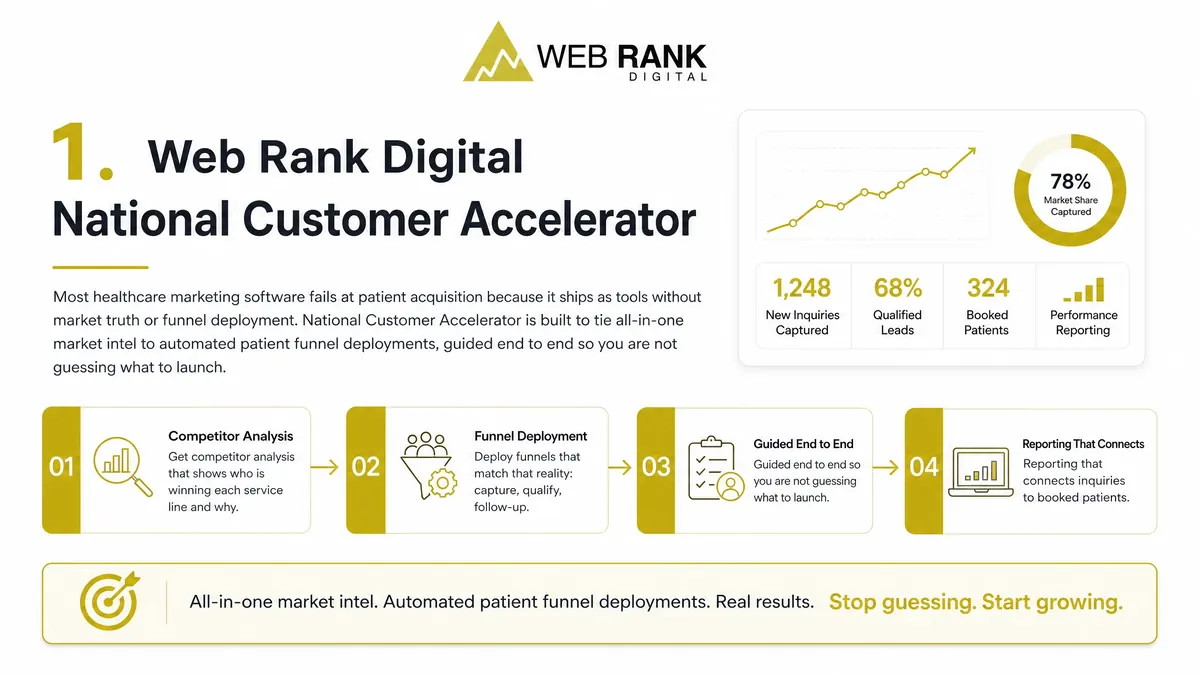
Most healthcare marketing software fails at patient acquisition because it ships as tools without market truth or funnel deployment. National Customer Accelerator is built to tie all-in-one market intel to automated patient funnel deployments, guided end to end so you are not guessing what to launch. You get competitor analysis that shows who is winning each service line and why, then funnels that match that reality: capture, qualify, follow-up, and reporting that connects inquiries to booked patients.
2. Local Falcon
Local Falcon is a visibility measurement tool, not patient lead generation software. Its core value is a local rank grid that shows how your Google Business Profile appears across a map, so you can see where you are strong, weak, or invisible block by block. You can also run location-level competitor comparisons, which helps you quantify who outranks you in specific pockets of your service area.
Where it stops is the funnel: it does not capture, nurture, route, or attribute patient inquiries. It measures exposure, then you still need an acquisition system to convert that visibility into calls and forms.
3. Semrush
Semrush is strong for demand capture planning because it shows you what patients already search and which competitors own those clicks. You can map service-line keywords, review competitor pages and ads, and prioritize topics by intent so your content calendar and PPC (paid search) are built around existing demand, not guesses. Where it stops is the healthcare conversion layer: you still need compliant landing pages, call and form tracking, fast lead routing, and follow-up automation so those clicks turn into patient inquiries you can measure.
4. Google Analytics 4
GA4 is your baseline proof layer: it answers which channels and which landing pages actually produce qualified inquiries, not just clicks. You should be able to pull a report that ties Source/Medium and Landing Page to conversions, then spot the pages that attract the wrong intent.
Because GA4 is event-based, track conversions as events you control (form submit, call click, appointment request) and pass a lead ID when possible.
None of this works without clean lead definitions. Align marketing and intake on what counts as qualified, unqualified, duplicate, and booked, or your reports will stay noisy.
5. Google Ads
Google Ads is the primary intent-capture channel because you can show up exactly when someone searches for a specific service, in a specific city, and is ready to call. You control lead quality by splitting campaigns by service line and by location (not one blended catch-all), then filtering with tight keywords and clear landing-page intent. The compliance risk is usually self-inflicted: policy-sensitive categories, unsubstantiated claims, before-and-after language, or implying outcomes you cannot prove.
Expect speed to first leads, but only if your claims and targeting stay conservative and defensible.
6. Meta Ads Manager
Meta Ads Manager is the highest volume demand-creation lever, and that is the risk: it builds top of funnel awareness fast, but it can flood intake with low-intent clicks if your targeting and offer are broad. Lead forms trade quality for speed; landing pages filter better because you control the message, eligibility, and next step. Treat creative and compliance as a gate, not a checkbox: avoid implying diagnoses or outcomes, keep claims plain, and run a documented review on every image, headline, and follow-up before scaling spend.
7. HubSpot
HubSpot is a CRM, not a patient demand engine. It helps you manage a pipeline, track every inquiry, and run consistent follow up so leads do not sit uncontacted or fall through handoffs between marketing and front desk.
Where it earns its keep is nurturing: automated email sequences, task reminders, segmentation, and basic reporting that shows which contacts moved from form fill to consult to booked. You can also standardize routing rules so the right team sees the right lead fast.
What it will not do by itself is create new market demand. If your issue is not enough qualified patient inquiries, a CRM only helps you process the leads you already generate.
8. Salesforce Health Cloud
Salesforce Health Cloud is the right backbone when you need enterprise patient workflows and a governed data model more than you need quick lead-gen wins. It shines when your teams must coordinate across care teams, service lines, and facilities using a consistent patient profile and process, not spreadsheets and one-off automations.
Integration is the point: you get mature connectors, identity and access controls, auditability, and admin-grade change management so marketing and reporting do not break every time a field name changes. The tradeoff is time to value for acquisition. Health Cloud will not ship patient inquiry volume by itself.
You still need acquisition tooling around it to run competitor-informed funnels, orchestration, and performance reporting.
9. Phreesia
Phreesia is patient intake and scheduling flow software, not a net new patient lead engine. It helps you move patients from appointment reminder to digital check-in, forms, insurance capture, and payment without staff chasing paperwork. Where it earns its keep is in-office conversion: fewer abandoned check-ins, cleaner data, and more completed preregistration steps that protect downstream billing and follow-up.
Use it to improve throughput and show rate, then pair it with separate acquisition software when your goal is new demand.
10. Birdeye
Birdeye is a conversion-rate multiplier, not a demand engine. When your funnels do drive clicks and calls, your reviews and accurate listings determine whether that interest becomes a booked patient, and it also reduces the reputation risk of “pushy” outreach. You use it to request reviews in a controlled, policy-aware way and keep NAP and hours consistent across directories so patients do not bounce.
Messaging matters for compliance and trust. A real feedback loop looks like: a post-visit text request, a private response path for complaints, and weekly theme tracking so you fix operational issues instead of arguing online. Keep Birdeye supporting your funnel; do not expect it to replace acquisition workflows.
11. CallRail
CallRail earns its spot here because renewals get decided on proof, and proof requires clean call and form attribution. You can track and record inbound calls so your team can QA intake, confirm lead quality, and resolve “the phone never rang” disputes with actual call logs. You can also attribute leads to the exact campaign that drove them, so spend decisions are based on source-level performance, not guesswork.
Integration is the gate: confirm your GA4 event mapping and your CRM sync for lead status and revenue fields before you sign.
Get a patient acquisition demo that starts with your market, not a tool list
If you want predictable patient inquiries, you need more than a CRM, reporting, or listings visibility. You need competitor and market intelligence that directly drives what you launch next, plus funnels that go live cleanly and stay measurable.
That is what we built Web Rank Digital National Customer Accelerator to do. We start by mapping your top service lines and target locations, then run a competitor analysis to pinpoint the gaps you can win. Next, we deploy one patient funnel per priority service line and validate tracking so calls and forms tie back to the channel and campaign that produced them.
You also get onboarding plus an account manager cadence, so performance does not drift after launch.
Schedule a National Customer Accelerator demo focused on your service lines, and ask us for your local competitor analysis, onboarding plan, and ongoing management rhythm before you commit.
Frequently Asked Questions
What is phreesia?
Phreesia is primarily a patient intake and scheduling workflow platform that helps improve the in-office and pre-visit experience. It can support conversion after a patient is already in your process, but it is not designed to be your primary engine for generating new patient demand.
What are the 5 P’s of healthcare marketing?
The 5 P’s are a classic marketing framework used to structure planning around your offering and how it is delivered and promoted. For patient acquisition software decisions, we recommend focusing less on theory and more on what you can measure and deploy: service lines, target locations, competitor gaps, funnel launch, and conversion tracking.
What is the best CRM software for hospitals?
The best CRM for a hospital is the one that fits your governance, integrations, and workflow requirements, and that your teams will actually use consistently. The key is to separate CRM needs from acquisition needs, then connect the two so leads and booked appointments can be attributed back to the campaigns and funnels that generated them.