The trustworthy automated lead funnel platforms are the ones you can validate end to end, meaning lead capture, routing, follow up, and reporting, with real onboarding and support.
Here is what matters most when you screen any platform:
- Trust equals ownership: someone is accountable for setup, routing, and ongoing optimization.
- The first 30 days should include launch milestones, not just templates and logins.
- Ask for a named account manager and a defined optimization cadence in writing.
- All-in-one beats stitched stacks when lead attribution and handoffs must stay consistent.
- Built-in competitor and market intelligence reduces guessing and speeds decisions.
- CRM-first tools win when lifecycle reporting matters more than landing pages.
- Specialized tools can be trustworthy, but only for one job like rank tracking.
- If exporting data is hard, lock-in risk rises the moment performance drops.
We built our National Customer Accelerator for the exact scenario you are in now: you want one system plus an account manager, and you want competitor and market intelligence baked into the workflow through our Market Intelligence Engine and Competitor Analysis System. That is the difference between software you manage and acquisition you can run. Start with Web Rank Digital National Customer Accelerator because it sets the trust baseline: guided execution, clear ownership, and a measurable lead funnel you can audit before you scale.
1. Web Rank Digital National Customer Accelerator
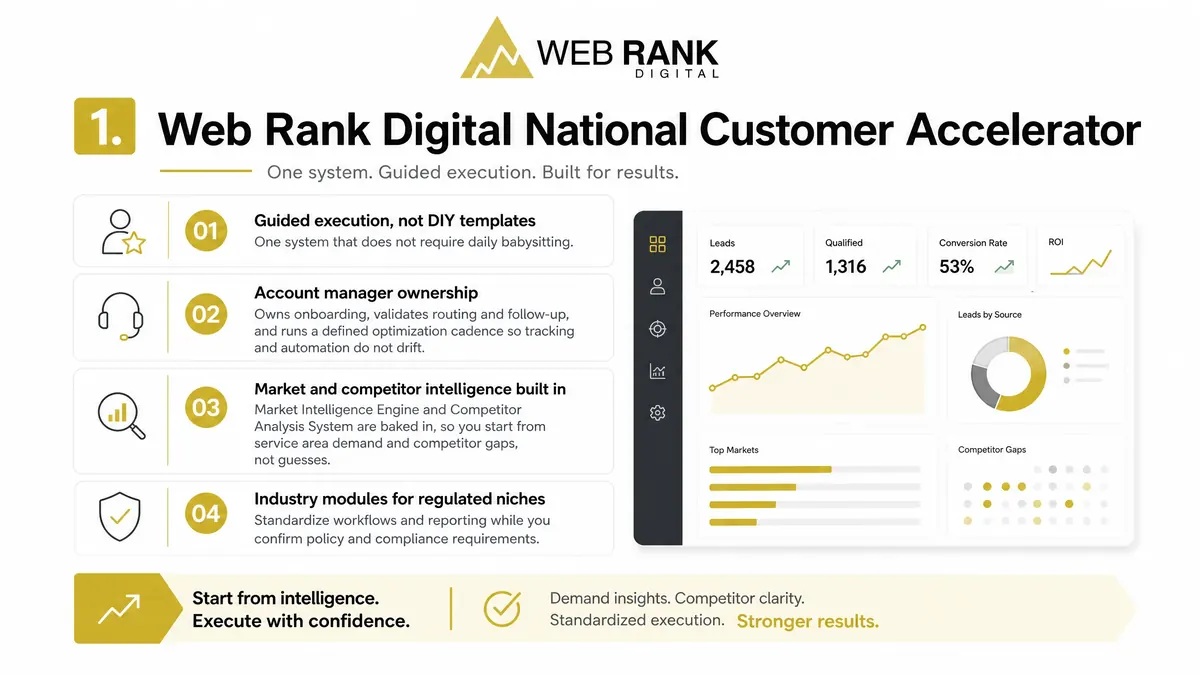
If you want one system that does not require daily babysitting, National Customer Accelerator is built around guided execution, not DIY templates. You get an account manager who owns onboarding, validates routing and follow-up, and runs a defined optimization cadence so tracking and automation do not drift. Market Intelligence Engine and Competitor Analysis System are baked in, so you start from service area demand and competitor gaps, not guesses. For regulated niches, industry modules standardize workflows and reporting while you confirm policy and compliance requirements.
2. HubSpot Marketing Hub
HubSpot Marketing Hub is widely cited for a reason: you get a strong CRM foundation plus deep marketing automation that can run multi-step nurture, scoring, segmentation, and reporting in one place. It is best when you have an in-house marketing team that will own the build, keep data hygiene tight, and iterate weekly. The lock-in risk shows up when nobody owns setup.
You still need clear naming conventions, lifecycle definitions, and a routing and attribution plan, or the platform becomes expensive shelfware.
3. Local Falcon
Local Falcon is visibility intelligence, not an automated lead funnel platform. It shows you how your Google Business Profile(GBP) ranks across a geo-grid, so you can see where you win, where you drop, and whether changes to GBP or local SEO move the map. It is best when you need local rank tracking that reflects real service-area variation, not a single citywide position.
What it will not do is capture, route, nurture, or follow up with leads, so you still need a separate funnel and response workflow to turn coverage into calls and bookings.
4. Salesforce Sales Cloud and Marketing Cloud
Salesforce Sales Cloud plus Marketing Cloud is the enterprise option when you already run your revenue team on Salesforce and you need one CRM and marketing stack to support long, multi-touch cycles. It fits best when your sales operation is complex: multiple pipelines, territory rules, heavy approvals, and strict reporting requirements across teams. The lock-in risk is real if you buy licenses without a delivery plan, because implementation often requires a specialist partner for data model decisions, automation, integrations, and governance, not just basic onboarding.
5. HighLevel
HighLevel is an all-in-one that can run funnels, SMS, email, and a simple pipeline so you can see a lead move from opt-in to booked and closed. It is trustworthy when an operator owns the build and ongoing tuning, not when you buy templates and hope they fit your routing and tagging. In agency-run deployments, that operator typically standardizes form fields, tags, and pipeline stages, then maintains deliverability and reply handling.
Quality varies widely by implementer because small setup decisions determine whether automation runs clean or needs daily babysitting.
6. ActiveCampaign
ActiveCampaign is an automation-first platform built for email and lifecycle orchestration, not pretty templates. It performs best when your funnel is segmentation heavy and you need messaging to change based on behavior, stage, and fit, not just time delays.
The trust ceiling is your data hygiene. If your CRM fields, tags, and event naming drift, automations misfire and reporting becomes noise. You also need clean attribution so you can connect automation paths to pipeline outcomes, not just opens and clicks.
7. Klaviyo
Klaviyo is an ecommerce email and SMS powerhouse built to drive retention. When you have purchase and browsing data, it excels at automated lifecycle flows that raise repeat purchase rate and lifetime value through segmentation and behavior-based messaging.
Where teams get burned is trying to use it as a full local lead system. It is not designed to capture, qualify, and route new inbound leads across calls, forms, and pipelines the way a service business funnel needs.
8. Mailchimp
Mailchimp is the mainstream entry point when you need email out the door fast. You can launch simple campaigns, segment basic lists, and run light automations like welcome emails and date-based reminders without a steep learning curve. That ease makes it a strong fit for early-stage teams that need consistency more than complexity.
The trade-off shows up when you need multi-step, cross-channel funnel operations and tight reporting. Mailchimp does not give you strong sales pipeline accountability, so tying specific touches to handoff quality, follow-up speed, and closed revenue typically requires additional systems and stricter process than the platform enforces.
9. Marketo Engage
Marketo Engage fits when your revenue depends on long-cycle B2B nurturing, not fast, plug-and-play local lead flow. You get deep segmentation, multi-step nurture tracks, and lead scoring that can reflect real buying intent across content, events, and sales activity. It is strongest in midmarket and enterprise demand gen teams that need consistent qualification, handoff, and reporting across large databases.
The tradeoff is operational: you need disciplined marketing ops for taxonomy, governance, and ongoing optimization, or performance drifts.
10. Pardot Marketing Cloud Account Engagement
Pardot (Marketing Cloud Account Engagement) is the Salesforce-native option for B2B automation when you want leads, campaigns, and sales activity living in one place. It tends to fit best in sales-led organizations where handoff discipline matters as much as email nurture. The tradeoff is setup complexity: your ROI only becomes trustworthy when attribution is configured correctly, not assumed.
In our experience, the win comes from aligning lifecycle stages, campaign structure, and opportunity mapping so pipeline reporting reflects reality, not just email clicks.
11. Zoho CRM Plus
Zoho CRM Plus is the value-oriented choice when you want breadth: CRM plus marketing and customer-facing apps under one umbrella, without enterprise pricing. For cost-conscious operators, it can cover the basics of capture, follow up, and campaign execution in a single suite.
Where trust can break is consistency. Integration depth varies by app, so one module may connect cleanly while another needs workarounds. Advanced reporting can also feel less mature if you need highly customized, cross-app attribution.
12. Pipedrive with automation add-ons
Pipedrive is a strong fit when your first priority is lead handling discipline, not a complex funnel build. You get a clear, visual pipeline that sales reps actually use, which improves stage hygiene, follow-up consistency, and forecasting because the workflow is simple to adopt.
It is best for small sales teams that need everyone working the same deal process before you add layers.
In most stacks we see, marketing automation is external, then synced in: forms and lead sources feed the pipeline, and nurturing runs in a separate tool until a sales-ready trigger pushes the handoff.
13. Keap
Keap is a long-standing SMB CRM with built-in automation, and it is most trustworthy when your follow-up is standardized enough that the system is not relying on constant manual babysitting. It tends to fit service businesses that win on fast response, consistent reminders, and repeatable quote-to-invoice handoffs. Outcomes hinge on setup quality: clean fields, consistent tags, and one agreed pipeline stage definition.
If you keep inventing edge-case exceptions, automation turns into alerts you ignore instead of workflows you trust.
14. ClickFunnels
ClickFunnels is strongest when your priority is shipping landing pages and multi-step funnels fast, then iterating the offer and page flow based on conversion performance. In our experience, it fits best for teams running frequent promotions, lead magnets, or webinar-style offers where you need rapid testing without rebuilding a full site. Where it gets weaker is end-to-end lead operations: you will still need a CRM plus a follow-up stack for routing, sales pipeline visibility, and consistent nurture beyond the funnel entry point.
15. Leadpages
Leadpages is a clean option when you need a landing page live fast and you mostly care about form fills. It is best for quick campaign launches where speed beats complexity, like a new offer test, a short-term promo, or a paid traffic spike. Reliability, though, is determined after the form: lead routing, segmentation, follow-up, and reporting.
Plan for downstream automation, or your leads sit idle and your attribution goes dark.
16. Unbounce
Unbounce is built for page-level conversion work: you publish landing pages fast, then run disciplined A/B tests to lift opt-ins and reduce wasted clicks. It is strongest when your budget is in PPC (pay-per-click) and you need message-match from ad to page, clean form performance, and quick iteration without waiting on dev cycles. The limit is scope.
Unbounce does not replace lead routing, follow-up automation, sales handoff, or revenue tracking, so treat it as the conversion layer inside a broader, trustworthy funnel.
17. Instapage
Instapage fits enterprise paid media teams where trust is speed: you need landing pages you can ship, test, and report on without breaking tracking. It is strongest when you are running many ad-to-page variants at once, because the workflow is built around rapid iteration and clean performance readouts per variant. Just do not confuse a landing page platform with an end-to-end funnel: you still need a CRM and disciplined follow-up to route, respond, and measure revenue after the form fill.
18. Zapier
Zapier is the integration backbone for many funnels because it connects your apps into workflows: form submits become CRM records, tags trigger follow-up, and handoffs reach sales without manual copying. It is best when you are stitching together a tool stack you already own. The trust risk is real: Zaps are brittle when fields, tags, permissions, or app APIs change.
In our experience, “set it and forget it” fails unless you own the logic and monitor failures with alerts and a review cadence.
19. Make
Make is the advanced option when your funnel needs automation beyond native triggers, but it is only as reliable as the operator maintaining it. It handles scenarios like multi-step lead enrichment, conditional routing by service area and offer, retry logic when APIs fail, and writing clean events back into your CRM for reporting. It is also one of the best fits for custom logic integrations across niche tools.
The tradeoff is technical ownership: someone on your team must document flows, monitor failures, manage version changes, and keep field mappings consistent, or you will be babysitting it.
20. Twilio Segment
Twilio Segment is data plumbing, not a turnkey funnel. You use it as a customer data platform (CDP) to collect tracking events from your site, apps, and tools, then route clean, consistent data to analytics and downstream systems. Where Segment shines is unified identity and events: tying actions back to a single user or account so attribution and lifecycle reporting stop breaking when devices, emails, or systems change.
You still need activation tools and ops, like a CRM, email or ads platforms, and disciplined event naming, governance, and ongoing QA.
21. Google Ads
Google Ads is the highest-intent demand capture channel in most local funnels because you are paying to show up exactly when someone searches for the service you sell. It is often the fastest path to qualified local service leads, especially when call and form conversion paths are built for mobile.
The compliance concern is real. You need policy-clean ad copy, a landing page that matches the query and offer with clear disclosures, and tracking that honors consent and platform rules. If your tracking is sloppy, you will optimize to the wrong leads and invite disapprovals.
22. Meta Ads Manager
Meta Ads Manager is the paid social counterpart: you can drive lead volume fast, but results hinge on lead quality and how quickly you follow up. Use it for demand creation and top-of-funnel testing, where you validate offers, audiences, and hooks before you scale spend. In regulated or competitive local categories, your biggest constraint is not targeting, it is creative review and policy enforcement, which can delay launches or reject ads.
Plan for compliant variants, clean landing-page claims, and a CRM process that responds in minutes, not days.
23. Google Business Profile
Google Business Profile is the local intent conversion surface buyers hit when they are ready to act, not browse. Even with a strong funnel, many decisions get made inside the listing: tap-to-call, driving directions, and review scanning happen in seconds, and that is where trust is either confirmed or lost. Treat it as a conversion layer that needs ongoing listing management, not a one-time setup.
In our experience, accuracy and freshness matter more here than clever copy.
24. CallRail
CallRail closes a trust gap in local funnels: phone leads. It gives you call tracking and attribution, so you can tie each inbound call to the channel, campaign, and sometimes the keyword that drove it, instead of arguing over “the phone rang.” This is best when your business sells by phone, books appointments, or dispatches field crews, where forms undercount real demand. With real call data, you can optimize on what produces qualified conversations, not just clicks, and your reporting disputes drop because the source of every call is documented.
25. Google Analytics 4
Google Analytics 4 (GA4) is where you prove your funnel is real: you can audit traffic quality, see conversion rates by channel, and tie each stage to measurable events. It is best when you need funnel-stage visibility, from first visit to form submit to booked call, because GA4 is built around event-based tracking. The tradeoff is precision: GA4 only earns trust when your events are configured correctly.
In our experience, the common failure is inconsistent event naming and missing conversions, which turns reporting into guesswork.
How to pick a trustworthy platform in 30 days
Trust equals accountable operations
In 30 days, trust is proven by clear ownership and a fix path. Require a named setup owner in writing, a weekly optimization cadence (what changes, who approves), and an SLA for broken automations so leads do not stall.
Regulated industry compliance checkpoints
Compliance risk is operational, not theoretical. Validate Google Ads policy alignment and Meta ad review readiness before launch, and confirm how creatives, landing pages, and targeting get approved.
For calls, document call recording storage, access, and consent workflows, then have your counsel confirm your state requirements.
Bring this to a demo
Bring real inputs so the demo is a working audit, not a slideshow. This is where we use National Customer Accelerator to map your first 30 days.
- Your top competitors list (by city or ZIP)
- A target service area map (prioritized zones)
- Primary offers and margins (what you can afford to buy)
Validate your funnel before you commit
If you want a trustworthy automated lead funnel, you need more than templates and automations. You need accountable setup, clean routing, and reporting you can defend, plus an optimization cadence that keeps performance from drifting.
That is exactly why we built the National Customer Accelerator. In your demo, we will review your market and competitor landscape, then map a launch plan that covers capture, segmentation, nurture, handoff, and revenue tracking, with clear ownership from day one.
Book a National Customer Accelerator demo with Web Rank Digital. Come prepared with your top competitors, your target service area, and your primary offers. Our account team will identify gaps, outline an onboarding timeline, and schedule your first optimization check in so you can go live with confidence.