The best marketing software for HVAC leads and conversions is the platform that can spot competitor gaps in your service area and run 24/7 automated lead capture and follow-up across calls and forms. If a tool cannot do both, it usually turns into a contact database, not a conversion system.
Here’s what matters most when you compare HVAC marketing software in 2026:
- Start by naming your service area and 3 to 5 local competitors.
- Prioritize competitor gap detection so you can target demand others miss.
- Require 24/7 service inquiry response automation so leads never wait until morning.
- Use automated lead funnels that follow up by channel, not one-size-fits-all blasts.
- Validate seasonal demand optimization for summer cooling and winter heating surges.
- Separate residential vs commercial lead nurturing so messaging matches urgency and deal size.
- Confirm onboarding speed plus account manager support, or adoption will stall.
We built the National Customer Accelerator (HVAC Module) for this exact problem: competitor gap detection plus automated lead capture, lead nurturing workflows, and seasonal optimization in one customer acquisition software platform. With 15+ years in customer acquisition and 1,000+ clients supported, our bias is toward measurable conversion lift, not software sprawl. Next, we will start with the Web Rank Digital National Customer Accelerator HVAC Module and show how competitor gap detection turns “too much competition” into a clear list of winnable leads.
1. Web Rank Digital National Customer Accelerator HVAC Module
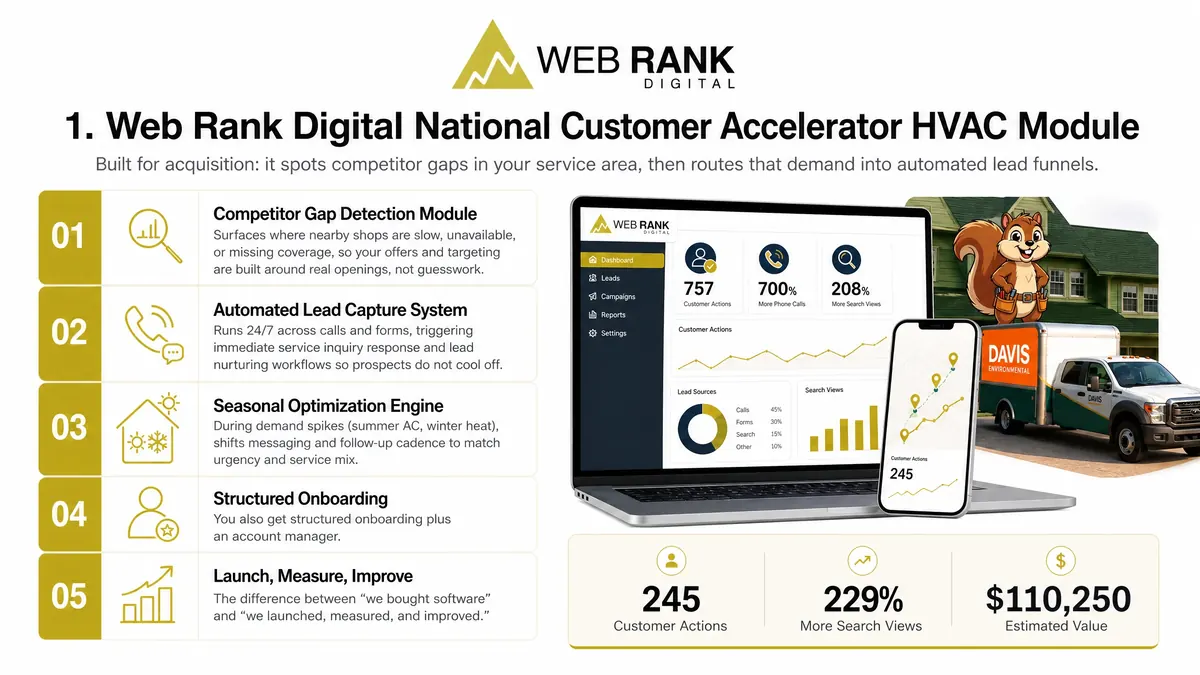
If you are worried a generic CRM will just store contacts instead of growing booked jobs, you are right to be skeptical. Web Rank Digital’s National Customer Accelerator HVAC Module is built for acquisition: it spots competitor gaps in your service area, then routes that demand into automated lead funnels.
The Competitor Gap Detection Module surfaces where nearby shops are slow, unavailable, or missing coverage, so your offers and targeting are built around real openings, not guesswork. From there, the Automated Lead Capture System runs 24/7 across calls and forms, triggering immediate service inquiry response and lead nurturing workflows so prospects do not cool off.
During demand spikes (summer AC, winter heat), the Seasonal Optimization Engine shifts messaging and follow-up cadence to match urgency and service mix. You also get structured onboarding plus an account manager, which is the difference between “we bought software” and “we launched, measured, and improved.”
2. HubSpot Marketing Hub
HubSpot Marketing Hub can drive measurable HVAC lead conversion when you actually use its email and workflow automation to respond fast, route leads, and keep follow-up consistent. Harvard Business Review research found companies responding within one hour are 7 times more likely to qualify leads, and HubSpot is built for that kind of triggered outreach at scale.
Where it gets heavy is implementation. You are buying a deep CRM and reporting ecosystem, not just campaigns, so lifecycle stages, properties, and attribution need clean configuration to avoid “busy work” dashboards. It fits best when you have marketing ops capacity, or a partner who can deploy and optimize.
For booked-job HVAC teams, the platform works only if configured around service types and real intake, not generic funnels.
3. Housecall Pro
Housecall Pro is strongest when your priority is tighter day-to-day service operations plus cleaner customer communication, not net-new HVAC demand creation. You get automated appointment reminders and job updates that reduce no-shows and keep customers informed without your team chasing texts and calls. It also supports payments and an end-to-end service workflow, so jobs move from booking to invoice with fewer handoffs.
That makes it a retention tool for your existing book of business. For lead generation, you typically still need separate channels or add-ons to drive new calls and form fills.
4. Brevo
Brevo is a budget-friendly choice when your HVAC team mainly needs dependable email plus SMS automation to stop leads from going cold. You can stand up nurture sequences quickly, then let them run in the background for estimates, maintenance reminders, and “we missed you” follow-ups. Where Brevo tends to shine is reactivation: simple win-back segments and timed messages that bring lapsed customers back into a booking conversation.
The tradeoff is reporting that is less HVAC-specific, so you will do more manual interpretation to tie campaigns to calls and booked jobs.
5. ServiceTitan Marketing Pro
ServiceTitan Marketing Pro can make ROI clearer when you already run jobs and customer history in ServiceTitan, because it is strongest at installed-base marketing: reactivating past customers, targeting by service type, and tightening follow-up around real service events. The real advantage is attribution tied to service records, so you can connect a campaign to booked calls, completed jobs, and revenue without stitching systems together. It is best fit for larger ops teams with 10-20+ techs and dedicated admin capacity.
The tradeoff is rollout: expect heavier implementation, data cleanup, and structured training before you see consistent execution.
6. Scorpion
Scorpion is an agency-led option where you buy managed marketing plus a supporting platform, not just software you run yourself. For many HVAC operators, the appeal is simple: you get execution handled for you, with lead tracking and reporting designed to show what is driving calls and form fills.
It tends to fit best when you want a hands-off model and are willing to operate within Scorpion’s process. Your level of software control can vary by package, so confirm upfront what you can edit, export, or keep if you ever change vendors.
7. Local Falcon
Local Falcon is a map ranking diagnostic, not marketing software for HVAC lead conversion. It runs local map rank grid reporting, so you can see how your Google Business Profile visibility changes across a service area instead of relying on a single “average” position. That makes it strong for location visibility decisions like where to prioritize GBP work or whether you need separate location strategies.
What it does not do is capture leads, route calls, or run follow-up. Pair it with a lead capture and automation system so improved visibility turns into booked jobs.
8. BrightLocal
BrightLocal is a strong operational layer for local SEO visibility: you use it to standardize citations, track rankings, and produce clean location-level reports that show where demand is being won or lost. It also supports reputation monitoring workflows by centralizing review tracking so you can spot drops in sentiment and respond faster. Where it shines is multi-location oversight, since reporting and citation work scales by location.
What it does not solve is conversion follow-up; you still need separate automation to capture, route, and nurture leads after the click or call.
9. CallRail
CallRail solves the HVAC measurement problem when the phone is your primary conversion point. You can assign tracking numbers to channels and campaigns, then tie each booked job back to the real source so ROI is not a guessing exercise. It works cleanly across paid search, social ads, and Google Local Services Ads, which is critical when LSAs drive high-intent calls.
The tradeoff: CallRail is attribution and conversation tracking, not full lead nurture, so you still need a separate platform for automated follow-up workflows.
10. Google Local Services Ads
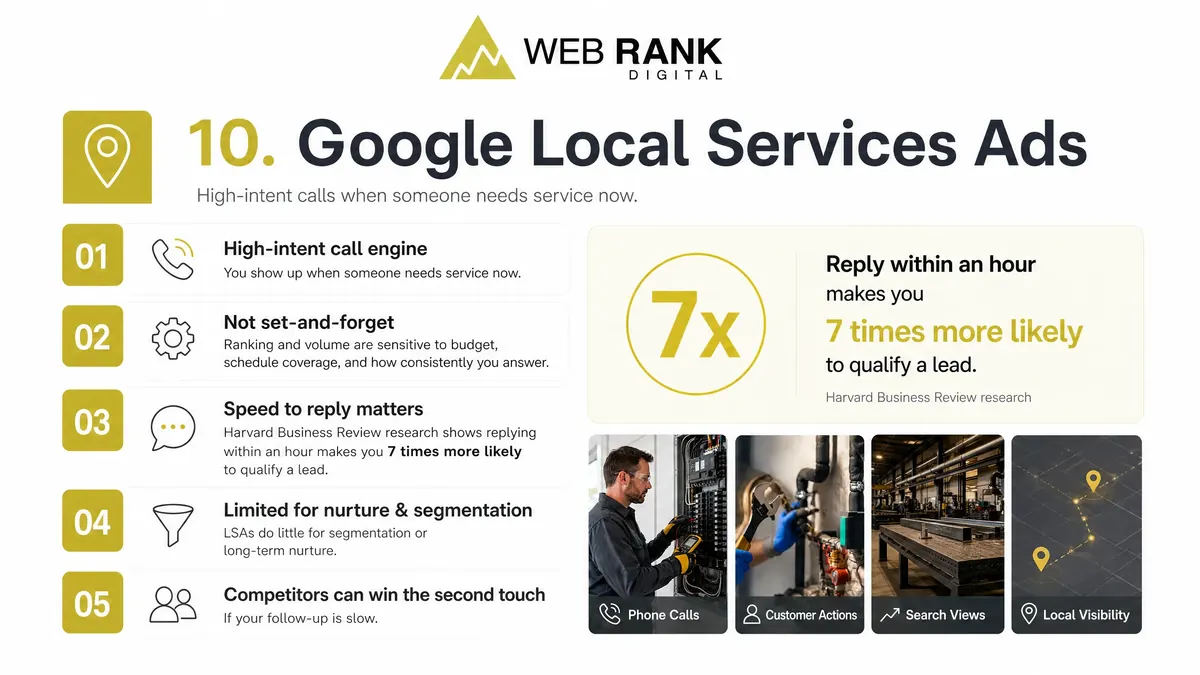
Google Local Services Ads are a high-intent call engine: you show up when someone needs service now and the lead is usually a phone call, not a long form. The catch is you cannot treat LSAs like set-and-forget software. Ranking and volume are sensitive to budget, schedule coverage, and how consistently you answer.
Close rate lives or dies in lead handling; Harvard Business Review research shows replying within an hour makes you 7 times more likely to qualify a lead. LSAs also do little for segmentation or long-term nurture, so competitors can win the second touch if your follow-up is slow.
11. Google Ads
Google Ads is pure demand capture for urgent HVAC service: you show up when someone searches “AC not cooling” and needs help now. You control intent and geography by bidding on specific repair and install keywords and tightening service-area targeting so you do not pay for clicks you cannot serve. The software choice matters because ads only work if the landing page converts fast on mobile, and your speed-to-lead is measured and automated.
Harvard Business Review research shows responding within one hour makes you 7 times more likely to qualify leads, but that only counts if call and form tracking are configured and audited weekly.
12. Meta Ads
Meta Ads are best used as a volume and retargeting layer for install and maintenance offers, not as your highest-intent lead source. You can amplify seasonal promos to people who visited key pages, engaged with videos, or opened a lead form, then use instant forms to capture more submissions at lower friction, with the tradeoff that lead quality is mixed.
Speed is the difference maker. Harvard Business Review research found companies that respond within one hour are 7 times more likely to qualify leads, so you need fast routing, immediate confirmations, and persistent follow-up. Plan creative refreshes around heating and cooling cycles: new angles, new proof, and new offers each season to prevent fatigue.
13. HighLevel
HighLevel is a strong fit when you want landing-page funnels paired with SMS follow-up, without moving into enterprise marketing ops. For HVAC, the ROI comes from speed: text back new form fills in minutes, route replies to the right pipeline stage, and keep prospects moving toward a booked call. It also supports appointment and pipeline workflows, so your office team can see lead status, no-shows, and reactivation opportunities.
It is best when marketing owns the system. Quality depends on setup, so budget time for clean routing, compliant SMS, and ongoing optimization.
14. ActiveCampaign
ActiveCampaign is a strong fit when you need advanced automation and segmentation to drive maintenance plan upsells and win-back campaigns, not just send newsletters. You can build tight nurture tracks for long-cycle installs, where prospects may take weeks or months to decide, and use behavior-based tagging to keep residential, commercial, and replacement buyers on different paths. It performs best when your lists are clean and consistently tagged; messy data will dilute results fast.
For phone-first HVAC leads, plan on integrating call tracking or your phone system so call outcomes can trigger automations.
15. Mailchimp
Mailchimp is a solid pick when you need straightforward email campaigns and basic automations, not a full HVAC lead-conversion engine. You can run broadcasts, segment lists, and set up simple customer journeys, which makes it a practical tool for ongoing customer newsletters and seasonal reminders.
Where it falls short for HVAC growth is multi-step lead handling. It is not designed to manage speed-to-lead, route inquiries, and persist follow-up across channels the way a customer acquisition platform does.
To get real ROI, you need tracking discipline: consistent list hygiene, tagged campaigns, and closed-loop reporting that ties sends and clicks back to booked calls and form fills.
16. Twilio Segment
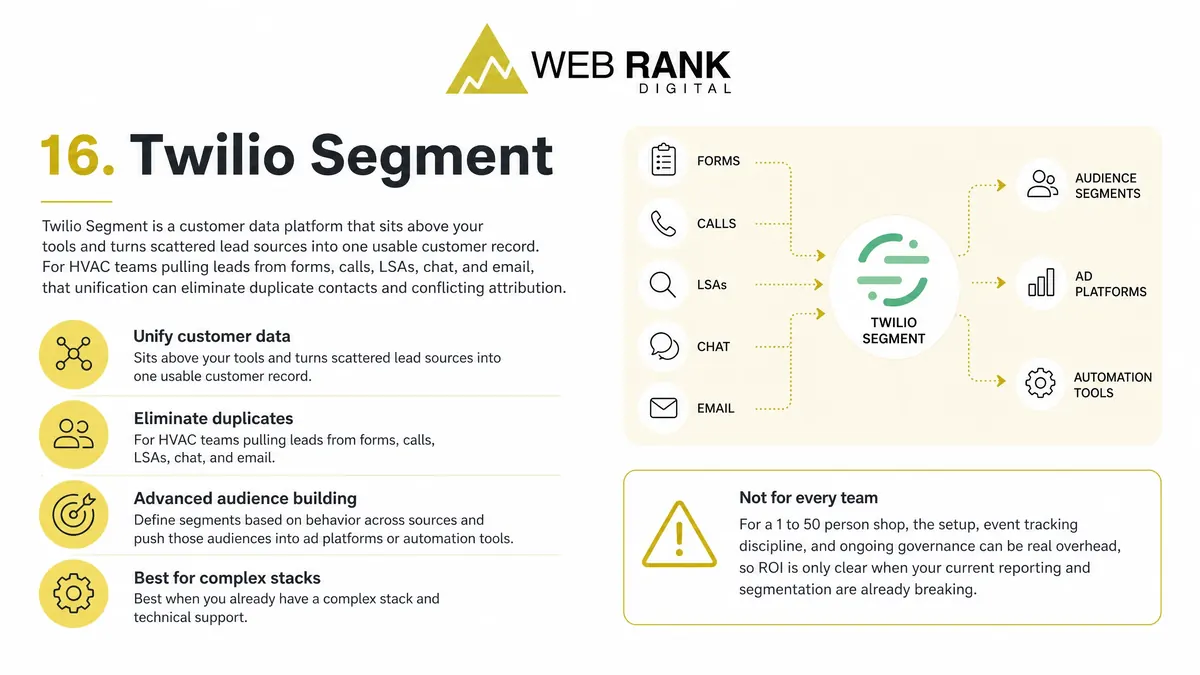
Twilio Segment is a customer data platform that sits above your tools and turns scattered lead sources into one usable customer record. For HVAC teams pulling leads from forms, calls, LSAs, chat, and email, that unification can eliminate duplicate contacts and conflicting attribution.
Where it gets powerful is advanced audience building: you can define segments based on behavior across sources and push those audiences into ad platforms or automation tools.
It is best when you already have a complex stack and technical support. For a 1 to 50 person shop, the setup, event tracking discipline, and ongoing governance can be real overhead, so ROI is only clear when your current reporting and segmentation are already breaking.
17. Zapier
Zapier is the lightweight glue that gets leads moving fast between tools, without waiting on custom development. You can push form fills into your CRM, attach call tracking details, and trigger immediate notifications so your team responds before leads cool off. The tradeoff is brittleness: a renamed form field, a new pipeline stage, or a vendor API change can quietly stop routing right when peak season hits.
Treat it like production infrastructure with simple monitoring routines: task-failure alerts, weekly spot checks, and a change log for every connected app.
18. Birdeye
Birdeye is reputation and messaging software that can lift your HVAC close rate indirectly by tightening trust signals and response loops. You use it to generate reviews after a completed job, monitor feedback across major review sites, and catch issues early so your ratings stay defensible in local search. It also consolidates customer conversations into a single inbox, reducing missed texts, web chats, and follow-ups that quietly kill booked calls.
It is not a competitor intelligence tool, so do not expect market gap insights.
19. Podium
Podium is strongest as a conversion support layer, not a primary acquisition engine. You use its SMS messaging and web chat to move prospects from “thinking” to “booked” fast, especially when you miss calls and need an immediate text-back to recover the opportunity. In some setups, Podium also supports taking payments inside the conversation, which can tighten collection on deposits or service fees.
Lead generation still depends on your existing traffic. No traffic in means no new conversations out.
20. Hotjar
Hotjar is a conversion-rate optimization tool that helps you see why your HVAC landing pages leak leads. Heatmaps show where visitors click, scroll, and stall, and session recordings reveal the real friction, like a CTA below the fold or a phone number missed on mobile. You can also pinpoint form drop-off so you know which field or step is causing abandonments.
It is ideal for landing page fixes, not demand generation. Without a traffic source sending enough visitors, the insights stay anecdotal.
Turn peak-season demand into booked jobs, not missed leads
If you want more HVAC calls and form fills when demand spikes, you need more than a place to store contacts. You need a system that captures every inquiry, responds fast, and shows you where competitors are dropping the ball so you can win the next job.
That is what we built the National Customer Accelerator (HVAC Module) to do. We start with your service area and your top 3 to 5 local competitors. Then we deploy automated lead capture and follow-up across calls and forms, and we optimize with seasonal demand signals and performance data.
Book your National Customer Accelerator HVAC demo with Web Rank Digital. Come prepared with your service areas, top competitors, and current lead sources. During the demo, ask us to walk through the ROI and CAC tracking dashboard so you leave with a funnel and tracking plan you can launch within days.
Frequently Asked Questions
How does the software help during peak HVAC season?
You use the Seasonal Optimization Engine to align campaigns to summer and winter demand shifts, while our Automated Lead Capture System keeps response and follow-up running 24/7. We also use competitor gap detection to prioritize the areas and times where missed calls and slow replies are most common.
Can the software convert leads that contacted a competitor first?
Yes. You can keep those prospects in play with Lead Nurturing Workflows that continue follow-up across the channels you rely on, so you stay top-of-mind when they are ready to book. This works best when messaging and offer timing are based on what your local competitor landscape is doing.
Does the software work for both commercial and residential HVAC?
Yes. You can segment by residential vs. commercial so your funnels, follow-up, and reporting match different job values, decision cycles, and service priorities. In practice, that means clearer attribution and cleaner optimization instead of mixing every lead into one generic pipeline.