The best marketing platform for pest control teams is the one that consistently lifts your Google Maps rankings and ties that visibility to measurable actions like calls, direction requests, and clicks.
Here’s the decision checklist that actually predicts local lead growth:
- Strong Google Business Profile (GBP) management beats dashboards that only report results.
- Heatmap tracking matters because rankings change street by street across your service area.
- Geo-targeted local keyword ranking shows whether “near me” visibility is improving by city.
- Automated directory management reduces citation errors that suppress local visibility.
- Onboarding plus an account manager prevents stalled setups and half-finished optimizations.
- Reporting must connect activity to calls, direction requests, and clicks, not vanity metrics.
We built our National Customer Accelerator and Local SEO by WRD around this exact reality: pest control growth lives in the map pack, and execution matters as much as software. With 15+ years of Local SEO experience, 1,000+ clients supported, and $50M+ in revenue generated, we focus on the metrics you can defend, then optimize until the map pack movement shows up in lead actions. Before you compare platforms like they are interchangeable, get clear on what a pest control marketing platform must do from lead to booked job, and which features actually create Google Maps lift versus just documenting it.
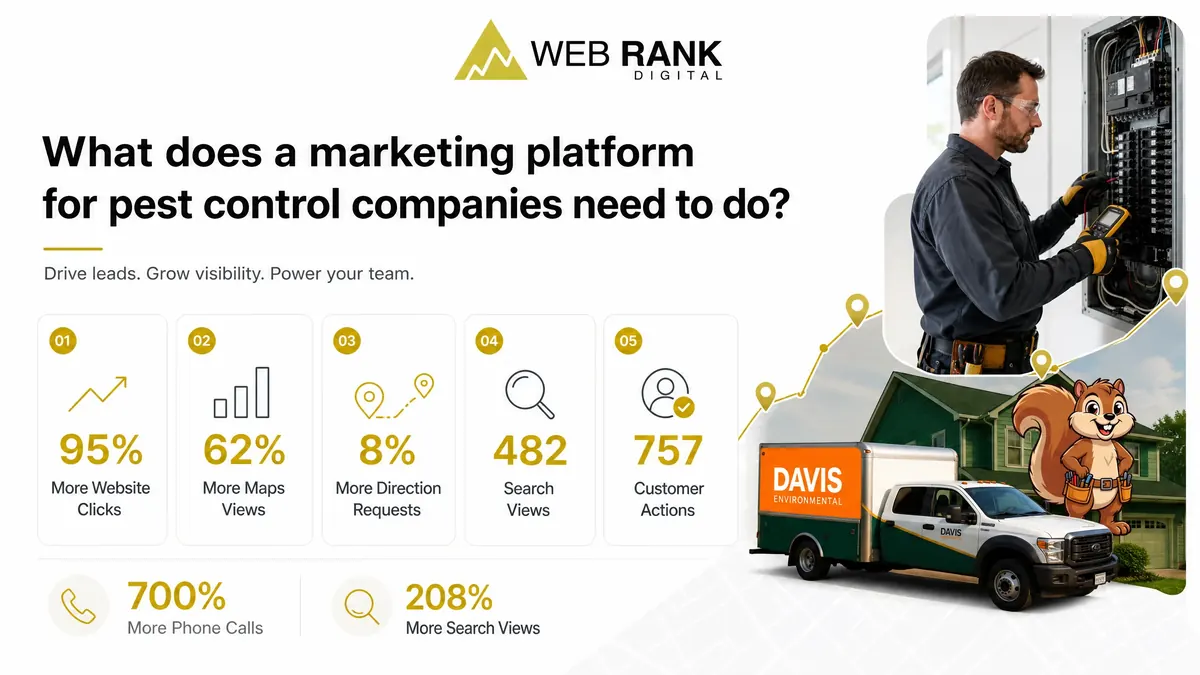
What does a marketing platform for pest control companies need to do?
From lead to booked job
A marketing platform is only doing its job if you can follow every lead through to a scheduled appointment and explain where the process breaks. That is the difference between “we got more visibility” and “we booked more jobs.”
You need speed-to-lead tracking that timestamps when the lead arrived, when you responded, and what happened next. In pest control, minutes matter, and without that timeline you cannot separate marketing problems from follow-up problems.
- Call and form capture that ties each inquiry to the specific source and keyword, not a generic “website lead” label
- A clean estimate-to-schedule handoff so a quote does not die in a text thread or a tech’s inbox
- Lost lead reason reporting (price, couldn’t reach, competitor, timing) so you can fix the real bottleneck instead of buying more leads
Attribution that survives phone calls
If most of your revenue closes on the phone, attribution has to persist after the click. Otherwise you will keep paying for channels you cannot prove and cutting the ones that are actually producing booked work.
At minimum, you need call tracking with recordings so you can validate lead quality and confirm which campaigns drive legitimate service requests. You also need UTM and GCLID storage so a click from Google can still be matched to a real conversation days later.
Finally, your reporting has to separate Google Local Services Ads from other Google traffic and support offline conversion imports so booked jobs and revenue can be pushed back to the ad platforms for optimization.
- Call tracking and recordings tied to the originating source
- UTM and GCLID storage on every lead record
- LSA lead source separation so it does not get blended into “Google”
- Offline conversion imports to connect booked jobs back to spend
How do we choose the best all-in-one growth platform for a pest control company?
The Pest Control Fit Scorecard
You avoid getting stuck by scoring platforms on operational proof, not feature lists. In 30 minutes, you can see whether the system will connect local visibility to revenue and still work in the real world of territories and multiple branches.
Use this scorecard and eliminate anything that cannot show the full loop from lead to completed work.
- Booked job reporting readiness: can it tie calls and forms to completed jobs, not just leads?
- Service area and territory logic: can you define service areas, overlap zones, and “do-not-serve” pockets without breaking reporting?
- Multi location visibility: can you compare Map pack performance and Google Business Profile changes by branch without exporting spreadsheets?
- Setup effort and ownership: who owns GBP access, directory listings, and tracking if you leave, and what can your team manage without a developer?
Red flags in demos
Demos are where “all-in-one” claims fall apart. You are looking for gaps that create lock-in: you pay, but you cannot prove outcomes or operate without ongoing paid help.
- No call attribution example: they cannot show a real call tied back to keyword, location, and GBP action.
- Pipeline but no scheduling: they show lead stages, but the workflow ends before an appointment or booked job exists in reporting.
- Reporting without job outcomes: dashboards stop at clicks, impressions, or “leads” with no booked or completed job view.
- Integration sold as custom work: core data connections are positioned as one-off development instead of a supported, repeatable setup.
Quick picks: best platforms by the way we grow
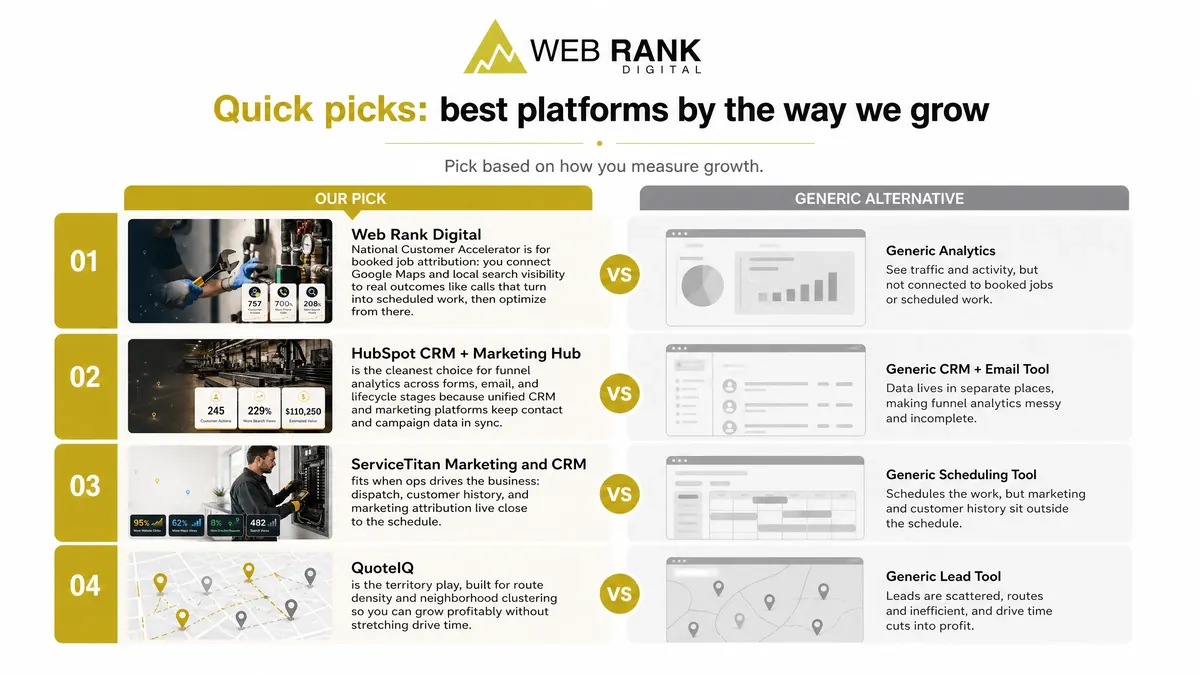
Pick based on how you measure growth. Web Rank Digital’s National Customer Accelerator is for booked job attribution: you connect Google Maps and local search visibility to real outcomes like calls that turn into scheduled work, then optimize from there. HubSpot CRM plus Marketing Hub is the cleanest choice for funnel analytics across forms, email, and lifecycle stages because unified CRM and marketing platforms keep contact and campaign data in sync. ServiceTitan Marketing and CRM fits when ops drives the business: dispatch, customer history, and marketing attribution live close to the schedule.
QuoteIQ is the territory play, built for route density and neighborhood clustering so you can grow profitably without stretching drive time.
Which platform wins on pest control marketing execution?
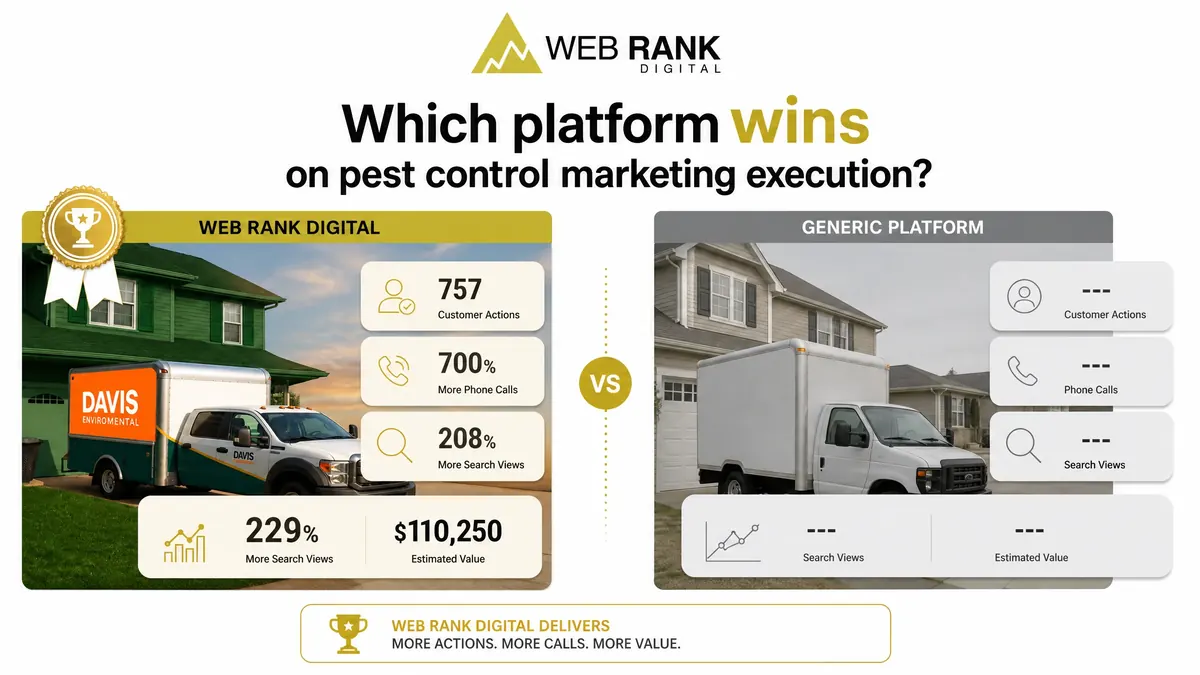
Web Rank Digital National Customer Accelerator
Execution wins when you can prove “map pack visibility to booked work” without building a complex stack. Our National Customer Accelerator is built to report from lead activity through to job outcomes, so you are not stuck defending vanity metrics.
Because it is designed for home services, the channel mix prioritizes local visibility workflows (GBP, geo-targeted keyword tracking, heatmaps, reviews, and directory consistency) instead of generic campaign types.
Governance is the differentiator: a defined optimization cadence with clear owners, plus fast creative and landing page deployment so testing does not stall in a queue.
- Lead to job reporting that ties activity back to outcomes
- Home services channel mix aligned to “near me” searches and service areas
- Cadenced optimization with governance (what changes, when, and why)
- Creative and landing page deployment built into execution
HubSpot CRM plus Marketing Hub
HubSpot is strongest when automation depth is your primary requirement. You can build complex nurture, lifecycle, and segmentation flows on top of unified CRM and marketing platforms.
You also get strong ad and email reporting, with high flexibility for teams that want to design everything from scratch.
The tradeoff for pest control operators is setup complexity and ongoing admin load, especially once automation and reporting move beyond the free and Starter tiers.
ServiceTitan Marketing and CRM
ServiceTitan leads on job and revenue visibility because marketing attribution sits close to operations. You can connect spend to booked jobs with fewer handoffs than a disconnected toolset.
It is the cleanest fit when you already run your shop on ServiceTitan and want tight operations integration.
The tradeoff is marketing agility: changes often depend on implementation timelines, contract structure, and add-ons, which can slow experimentation.
QuoteIQ
QuoteIQ is operationally valuable when territory and route density are the business priority. You can draw service zones, cluster work, and keep drive time from eating margin.
For field sales, lead management is practical: quotes, follow-up, and workflow live close to the day-to-day.
The limitation is marketing depth. It is not designed to run full local visibility execution across GBP optimization, heatmap-driven ranking improvements, and content deployment with governance.
The proof check: how we validate performance before we commit
Benchmarks we should track
To know if a platform produces booked jobs, you need a short list of operator metrics, not a dashboard tour. We use performance benchmarking to keep the conversation anchored in time, cost, and outcomes.
- Speed to lead: median under 5 minutes from form fill or missed call to first outbound attempt
- Call answer rate targets: set a baseline, then commit to a measured lift through routing, scheduling, and staffing changes
- Cost per booked job: total spend divided by confirmed bookings, not leads, not calls
- LSA to paid mix shifts: track where volume and booked jobs move when budget or ranking changes
Data we must be able to export
If you cannot export raw data, you cannot audit performance or switch providers without losing history. We treat exportability as a non-negotiable, because booked jobs require traceability from click to revenue.
- Lead source and UTMs for every form and call so you can separate Maps, organic, LSA, and paid
- Call logs and outcomes (answered, missed, qualified, booked) tied to the lead record
- Pipeline stage timestamps so you can measure speed to lead, follow-up cycles, and drop-off points
- Job revenue backfill fields so booked jobs can be reconciled to actual revenue
When we want the platform plus the team to run it
If you do not have time to administer tools, a managed platform model is the right call because it collapses setup, upkeep, and performance work into one accountable motion. With Web Rank Digital’s National Customer Accelerator, you are not just “turned on.” We deploy the local SEO stack and then optimize it in a weekly operating rhythm tied to Google Maps rankings and lead actions.
The biggest operational win is single ownership of the attribution stack. One team owns tracking, reporting logic, and the context behind every spike or dip, so you are not stitching together screenshots from multiple dashboards.
That structure is how you get to clean reporting faster: consistent definitions, fewer data gaps, and decisions made on calls, direction requests, and clicks. It is the best fit for lean teams that need outcomes, not another system to babysit.
See your Google Maps rankings translate into booked jobs
If your platform is not lifting map pack visibility and tying it to calls, direction requests, and clicks, you are paying for activity, not growth. We built the National Customer Accelerator to solve that exact gap with local SEO execution that is measured street by street, not just in dashboards.
In your demo, we will review your Google Business Profile categories, services, and service areas, then map your top competitors using heatmap and competitive intelligence. Next, we will set up geo-targeted keyword tracking by city and connect reporting to the actions that drive revenue. Calls.
Forms. Direction requests.
Your next steps are simple. List 10 service keywords by city you want to win. Then book a National Customer Accelerator demo so we can show you the gaps and the fastest path to local visibility gains.
Frequently Asked Questions
How long does it take to see results from local SEO for a pest control company?
You can usually see early movement after Google Business Profile clean up work, but meaningful gains tend to show up after consistent optimization over a few months. Most teams should plan for a 3 to 6 month window to see measurable improvements, then build on what the data proves is working.
What’s the difference between local SEO and paid search for pest control?
Local SEO improves your visibility in Google Search and Google Maps so you can capture high intent “near me” demand without paying for every click. Paid search buys immediate placement, but the lead flow stops when the spend stops. For many operators, the best mix is local SEO for durable map pack coverage, supported by paid search when you need to fill the calendar.
How do reviews impact pest control local search rankings?
Reviews are a core trust signal for Google Business Profile and they influence whether you show up and earn clicks in the map pack. Volume, rating quality, and response consistency all matter because they signal real customer engagement. That is why review management is not optional if you want stronger local visibility.