
The best lead generation software for your law firm is the one that increases local search and Maps visibility, finds competitor keyword gaps you can win, and tracks ROI from call and form fill to retained case value.
Here’s what matters most when you evaluate law firm lead generation software:
- Strong Local SEO and Google Business Profile optimization drives predictable, local high-intent calls.
- Competitor analysis and keyword gap detection shows which practice areas and ZIP codes can pay back.
- ROI tracking must connect Maps views, clicks, and calls to consults and retained clients.
- A monthly scorecard should include calls, clicks, direction requests, Maps views, consults, retained, case value.
- Expect ramp time, because search visibility gains compound over 3 to 6 months.
At Web Rank Digital, we built our National Customer Accelerator (Law Firm Edition) to tie competitor analysis, Google Business Profile optimization, and performance analytics into one measurable system, backed by 15+ years in customer acquisition and 1000+ clients supported. If you want one accountable platform instead of scattered tools, request a National Customer Accelerator demo and ask us for a competitor gap analysis so you can see your Maps and keyword gaps immediately. Before you compare platforms, you need a clean definition of a qualified lead for your firm, because that is what determines which calls count, what intake can trust, and what ROI actually means.
What counts as a qualified lead for a law firm?
Qualification signals intake can trust
A qualified lead is one your intake team can route confidently because it matches what you actually take, where you can take it, and how quickly action is needed. Volume is not the problem. Untriaged volume is.
We treat qualification as a short checklist that protects your calendar and your reputation by filtering out matters you cannot ethically or practically accept.
- Practice fit, jurisdiction, urgency: correct practice area, the matter occurred in your service area, and the lead’s timeline is clear (court date, active investigation, imminent deadline).
- Incident date and statute timing: the incident date is captured and reviewed against statute or notice deadlines before you invest attorney time.
- Ability to pay and coverage: you know whether this is contingency, hourly, flat fee, or legal insurance, and whether there is coverage (auto, homeowners, umbrella, employer, or other applicable policy).
Metrics that predict signed cases
Qualified leads still do not sign if your follow-up is slow or inconsistent. The operational metrics below are the ones that correlate with retained clients, not “leads delivered.”
Speed to contact is the first gate: the 2026 conversion benchmarks show leads contacted within 5 minutes are 21x more likely to convert than those contacted after 30 minutes.
Track conversion as a funnel by channel source: contact rate (you reached them), consult set rate (they booked), and signed rate (they retained). If one source produces high contacts but low signed rate, it is usually a qualification mismatch, not an intake effort problem.
What should lead generation software do end to end?
Capture and route every inquiry
If you cannot capture every inquiry, you cannot measure what is working. End-to-end lead generation software needs to log every call and message in one place, then push it to the right team fast enough to win the consult.
Call tracking with recordings is the baseline for quality control and dispute-proof reporting. Recordings let you audit lead quality, train intake, and verify what was promised on the first call.
You also need multiple capture paths because prospects do not behave consistently.
- Call tracking numbers by channel with recordings tied to each lead record
- Forms, live chat, and scheduling intake that create a lead automatically (not a manual copy-paste task)
- Routing rules by practice area and office location so immigration inquiries do not hit personal injury intake, and vice versa
Automate follow up and nurture
Speed to first response is a conversion lever you can actually control. Automation matters because 42% of legal service searches happen outside business hours, and AI intake can cut response times by 40% (AI intake ROI analysis).
Follow up should run without partner involvement, but still feel personal and compliant with your intake standards.
- SMS and email sequences that stop automatically once a consult is booked or a conflict is flagged
- Missed call text back that confirms receipt and offers the next best step (callback or booking link)
- Appointment reminders plus reschedule flows that reduce no-shows without staff chasing calendars
Prove ROI with clean attribution
The only attribution that matters is source of lead to signed client, mapped to practice area and office. Without that chain, you are optimizing for cheap leads, not retained matters.
Expect attribution gaps in common channels: LSA can obscure keyword intent, GBP actions can look like “direct,” and PPC often breaks when calls happen off-site. Your system should reconcile those gaps by tying calls, forms, and bookings to a single lead record and then to outcome.
- A lead timeline that tracks first touch, all follow ups, consult booked, and signed client status
- Channel tagging that handles LSA, GBP, and PPC without dumping everything into “organic” or “direct”
- Dashboards segmented by practice and office so you can see which location and service line is paying back
Best lead generation software for law firms in 2026: quick picks by situation
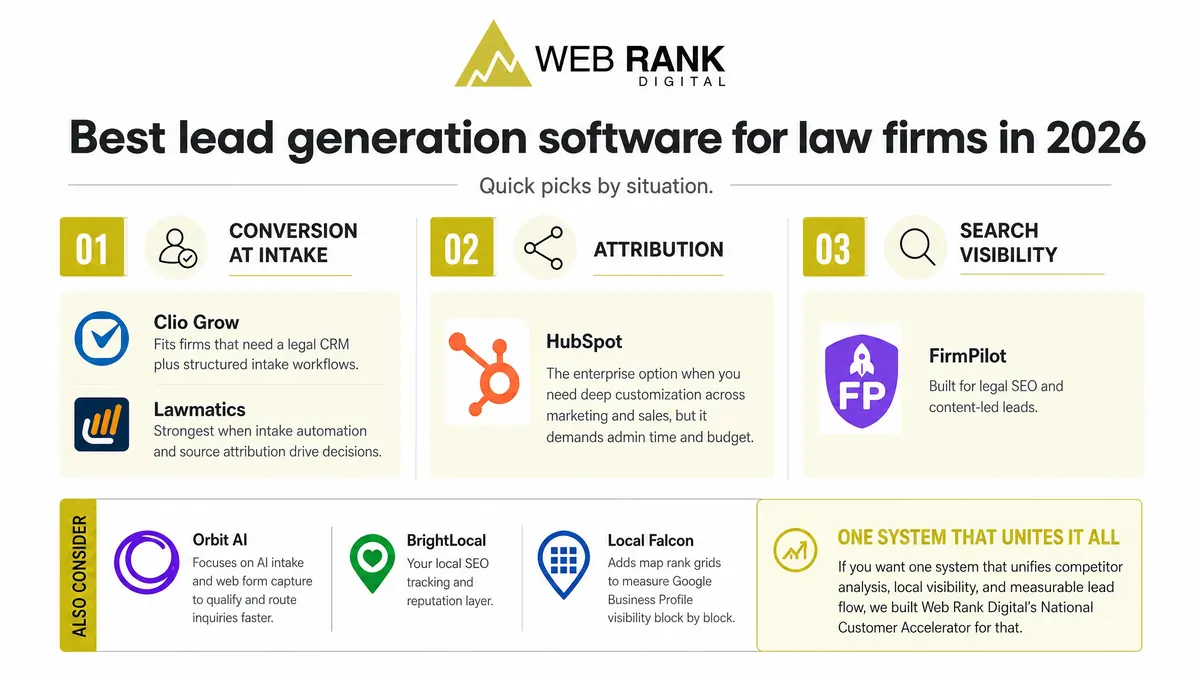
Pick based on your bottleneck: conversion at intake, attribution, or search visibility. Clio Grow fits firms that need a legal CRM plus structured intake workflows. Lawmatics is strongest when intake automation and source attribution drive decisions.
HubSpot is the enterprise option when you need deep customization across marketing and sales, but it demands admin time and budget.
For demand creation, FirmPilot is built for legal SEO and content-led leads. Orbit AI focuses on AI intake and web form capture to qualify and route inquiries faster. BrightLocal is your local SEO tracking and reputation layer; Local Falcon adds map rank grids to measure Google Business Profile visibility block by block.
If you want one system that unifies competitor analysis, local visibility, and measurable lead flow, we built Web Rank Digital’s National Customer Accelerator for that.
How do the top tools compare for intake, attribution, and local competition?
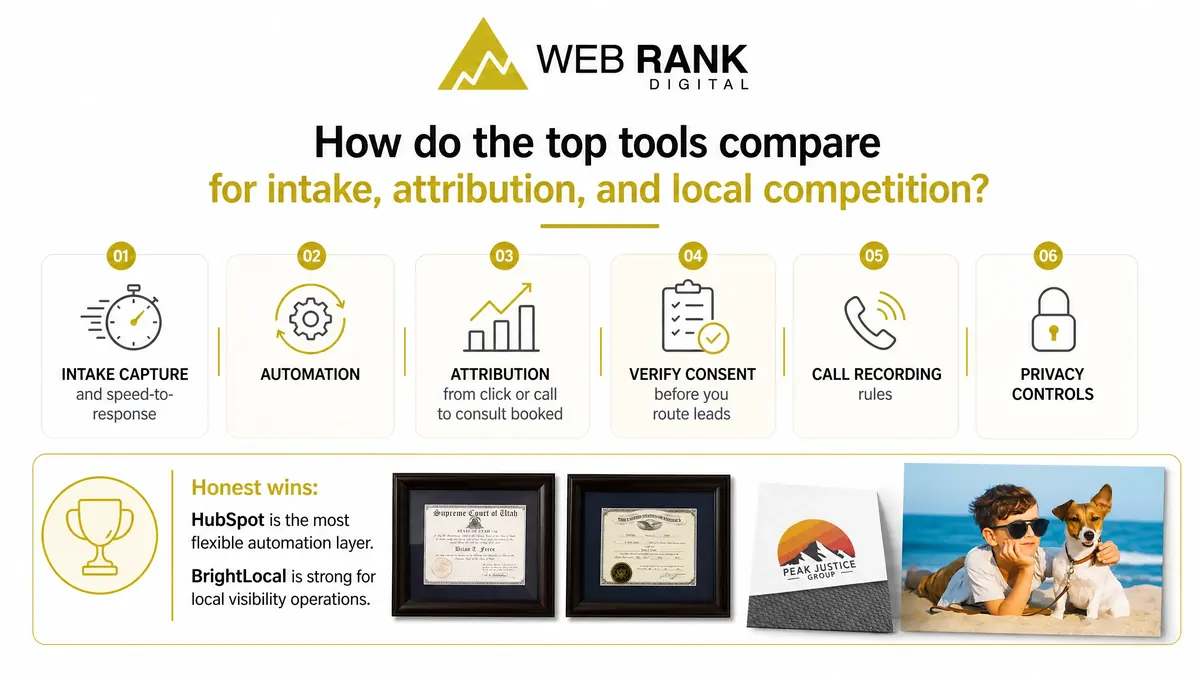
Use a simple scorecard: (1) intake capture and speed-to-response, (2) automation, (3) attribution from click or call to consult booked. Also verify consent, call recording rules, and privacy controls before you route leads.
Honest wins: HubSpot is the most flexible automation layer. BrightLocal is strong for local visibility operations.
Clio Grow
Clio Grow is strongest when your bottleneck is structured legal intake: forms, templates, e-sign, and appointment booking.
The real advantage is clean data handoff into the Clio ecosystem, so intake details do not die in someone’s inbox. Best fit: firms already running Clio.
Lawmatics
Lawmatics is built for firms that want intake automation plus campaigns that keep leads warm.
It stands out on attribution and ROI-style reporting inside a legal-focused workflow. Best fit: marketing-heavy firms willing to invest time in setup.
HubSpot
HubSpot wins on cross-channel automation and analytics when you need enterprise-grade reporting.
You will need legal-specific customization to reflect conflict checks, consult scheduling, and lead stages. Best fit: multi-location teams standardizing processes.
FirmPilot
FirmPilot is a legal SEO and content engine that can drive more organic demand, especially in competitive practice areas.
Best fit: firms prioritizing organic lead growth; the limit is it is less CRM-centric for end-to-end intake.
Orbit AI
Orbit AI is a fit when you need faster form workflows and AI qualification so good leads get routed immediately.
It improves intake responsiveness, but you typically still need a broader stack for attribution and ongoing marketing operations.
BrightLocal
BrightLocal is for local rank tracking and review monitoring, not intake.
It also handles citation and listing management well, which is why it wins for local visibility operations across locations.
Local Falcon
Local Falcon is purpose-built for geo grid map rank tracking, so you can see how Google Business Profile visibility changes block by block.
It is excellent for hyperlocal competitive insight; the limitation is no CRM or automation layer. geo-grid rank tracking
Web Rank Digital National Customer Accelerator
National Customer Accelerator is implementation-led: we connect multi-channel attribution with competitor analysis and Maps visibility so you can tie spend to booked consults.
Where point tools fall short is the competitor gap to booked-consult workflow: identifying ZIP-code and keyword gaps, deploying fixes, then optimizing to calls, clicks, direction requests, and consults set.
- Deployment: Google Business Profile optimization, keyword rank tracking, heatmap audits, and tracking setup
- Optimization: ongoing competitor monitoring and reporting that stays tied to lead flow, not vanity metrics
What is the best competitor gap analysis tool for a local law firm?
The best tool is the one that turns “they outrank us” into fixes you can ship: where you are losing on Maps, what your competitors are signaling in GBP, and which gaps tie to calls and consults. In our Web Rank Digital National Customer Accelerator, we map those gaps to intake actions (pages to build, GBP edits to make, review asks to deploy) so you are not stuck with a static report.
Gap signals that matter locally
Local gap analysis works when you track what Google can verify at a ZIP-level, not what feels true across your city.
Focus your audit on three signals that typically explain why a competitor shows up in the map pack while you do not.
- GBP categories and services gaps: competitor primary category, service list completeness, and practice-area alignment to your highest-value cases
- Map pack rank grids by zip: use geo-grid rank tracking to see where you drop out of the top 3, block by block, not in an “average rank”
- Review velocity and sentiment gaps: whether competitors are earning new reviews faster, and whether language in reviews reinforces the same practice-area terms you want to win
BrightLocal vs Local Falcon
BrightLocal is stronger when you need ongoing reporting and listings hygiene across locations. Local Falcon is stronger when you need precise grid maps to prove where visibility breaks down.
Use BrightLocal for: local reporting cadence, citation and listings workflows, and broad competitor comparisons. Use Local Falcon for: high-resolution map grids that isolate specific ZIP pockets to prioritize.
Best use: BrightLocal for ongoing monitoring; Local Falcon for spot checks after GBP or content changes and before you expand into a new service area.
Our 30 day rollout plan to turn tools into signed cases
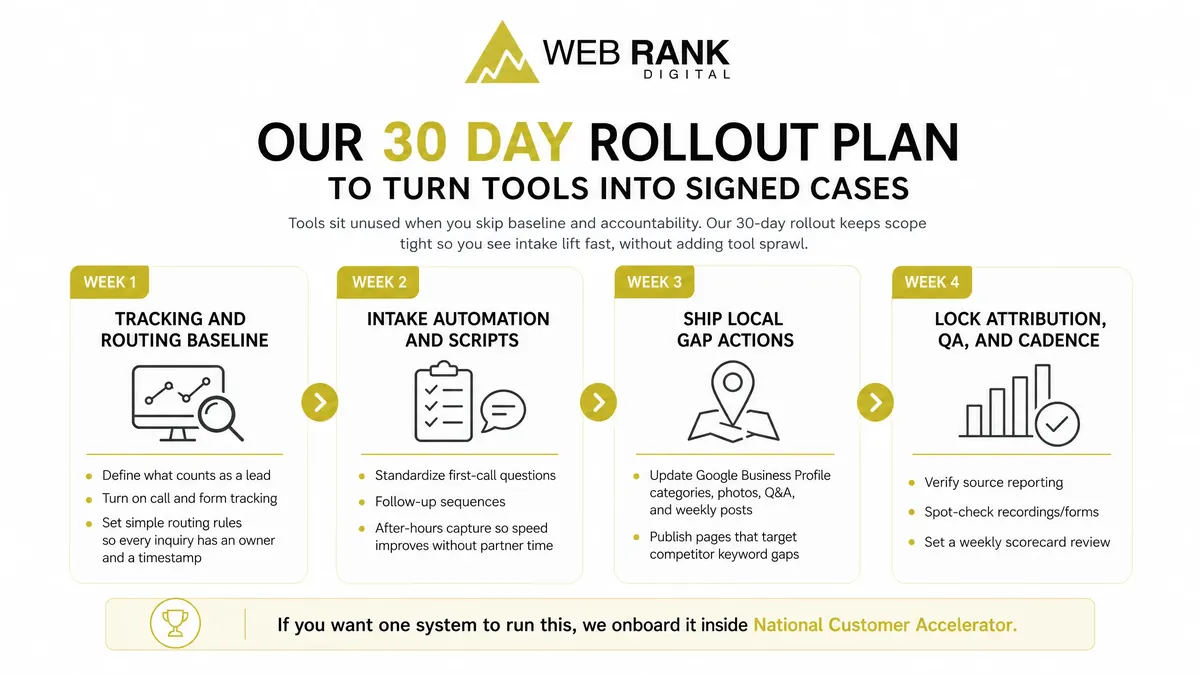
Tools sit unused when you skip baseline and accountability. Our 30-day rollout keeps scope tight so you see intake lift fast, without adding tool sprawl.
Week 1 is tracking and routing baseline: define what counts as a lead, turn on call and form tracking, and set simple routing rules so every inquiry has an owner and a timestamp.
Week 2 is intake automation and scripts: standardize first-call questions, follow-up sequences, and after-hours capture so speed improves without partner time.
Week 3 ships local gap actions: update Google Business Profile categories, photos, Q&A, and weekly posts, then publish pages that target competitor keyword gaps.
Week 4 locks attribution, QA, and cadence: verify source reporting, spot-check recordings/forms, and set a weekly scorecard review. If you want one system to run this, we onboard it inside National Customer Accelerator.
Turn local visibility into retained cases you can measure
If you are tired of paying for leads that never retain and tools that drain partner time, you need a system that ties local demand to real outcomes. We built the National Customer Accelerator (Law Firm Edition) to do exactly that by connecting Google Business Profile optimization, competitor gap analysis, and ROI tracking in one dashboard.
In your demo, we will walk you through your highest intent practice area and ZIP code opportunities using our Competitor Analysis Engine and Keyword Rank Tracking Dashboard. Then we will show you how to start tracking the metrics that matter immediately: calls, clicks, direction requests, Maps views, and search views, all inside Performance Analytics and Reporting.
Book a National Customer Accelerator demo through Web Rank Digital and request your competitor analysis so you can see your Maps and keyword gaps and prioritize the next 30 days with confidence.
Frequently Asked Questions
What is lead gen software?
Lead gen software helps you create and capture demand, not just organize contacts. For law firms, that means improving local and Maps visibility, identifying competitor keyword gaps, and tracking calls and inquiries through to retained case value.
How is lead value calculated in the software?
We estimate lead value based on your case type and practice area, then map that value to the specific sources generating calls and form fills. That lets you evaluate performance by location and service line instead of guessing which channels are paying back.
What metrics matter most for law firm lead generation?
Track the leading indicators first: phone calls, website clicks, direction requests, search views, and Maps views. Then tie those to consults set and retained clients so you can spot where visibility is rising but conversion is breaking.
How long does it take to see results?
Most firms see measurable improvements in about 3 to 6 months as Google Business Profile optimization and local SEO changes compound. You should still expect early signals sooner, like improved Maps views and keyword movement, before retained cases catch up.