The lead generation software that reliably delivers contractor leads and ROI is the one that starts with competitor analysis and service area market intelligence, then runs a trackable funnel from lead capture to booked job.
Here is what matters most:
- Define your service ZIPs and your top job types before you spend a dollar.
- Use competitor analysis to find market gaps, not a bigger list of shared leads.
- Track calls, forms, and booked jobs together or ROI stays invisible.
- Pilot one location first, then scale only after results are predictable.
- Prioritize fast response on high intent inbound to stop leak-before-quote losses.
We built the National Customer Accelerator to do this the operator way: market opportunity identification plus competitor analysis, then customer acquisition workflows and a performance dashboard that makes ROI measurable. With 15+ years in customer acquisition and 1,000+ clients supported, we have seen the same pattern repeat, and we designed the system to prevent the first 30 days waste. Next, you will map what lead generation software for contractors actually needs to do, in order, to produce ROI in your local market.
What does lead generation software for contractors need to do to produce ROI?
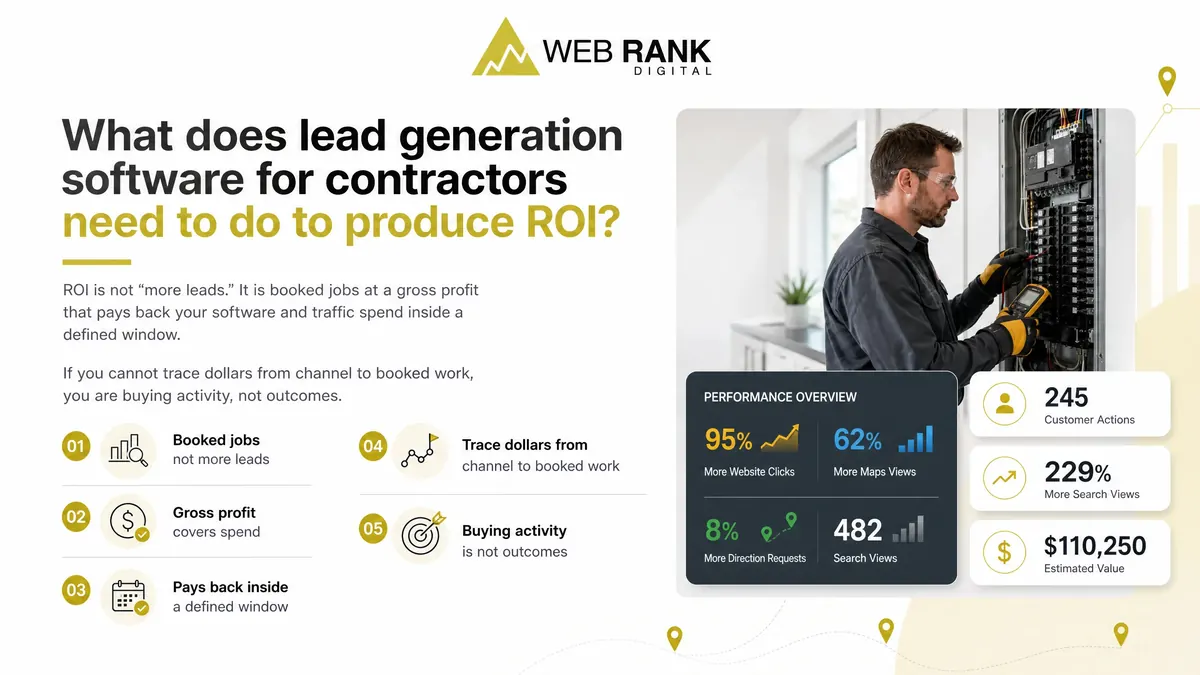
ROI is not “more leads.” It is booked jobs at a gross profit that pays back your software and traffic spend inside a defined window. If you cannot trace dollars from channel to booked work, you are buying activity, not outcomes.
The ROI chain to booked jobs
Lead gen software produces ROI only when it runs a measurable chain from first click to booked job, not just lead capture. The fastest way to waste money is letting any link in that chain go untracked for the first 30 days.
Evaluate every channel the same way: traffic has to become a lead, the lead has to become a real contact (answered call or two-way text), and contacts have to convert into estimates and closes. Then you judge success by gross profit per booked job, not revenue, because gross profit funds overhead and future acquisition.
Your payback window should be set per channel, because intent differs. A high-intent emergency call should pay back faster than a low-intent form fill, or you pause spend and fix the handoff.
- Traffic to lead to contact: clicks or impressions mean nothing until you measure reached conversations
- Contact to estimate to close: track each stage so you can see where you are leaking margin
- Gross profit per booked job: the number that determines whether the system scales safely
- Payback window per channel: set a time limit to prove profit, then optimize or cut
Benchmarks worth using in 2026
Use benchmarks that force operational discipline. Speed-to-lead is measured in minutes, not hours, because the first responder usually wins the conversation, not the best advertiser.
Harvard Business Review research found an average 42 hours to make first contact with web-generated leads among companies that responded within 30 days, and 23% never responded at all. That is the bar you clear by default.
Set thresholds by lead type and trade so you can diagnose problems: a missed call is a process issue, a low booked rate after estimates is often pricing, scope, or sales execution.
- Speed-to-lead: target minutes for calls, texts, and forms, with alerts when you miss it
- Call answer rate: hold your team to a high answer rate during business hours, with overflow routing after-hours
- Contact rate by lead type: calls should contact higher than forms; forms need rapid text-back and retry logic
- Booked rate by trade: expect different close behavior for plumbing, HVAC, electrical, and pest control, and benchmark each separately
Which tools actually bring in customers, not just leads?
Quick pick scorecard that matters
Tools that produce booked jobs do four things: contact fast, prove the source, show the sales stage, and tie outcomes to revenue. Anything else is just organized data.
Use this scorecard to keep the conversation in the pipeline, not the dashboard:
- Speed-to-lead automation depth: Can it reply in minutes by call and text, route by service and ZIP, and keep following up until you get a yes or no? Harvard Business Review research found companies that did respond still averaged 42 hours to first contact.
- Attribution and call tracking: Does every call and form submission carry the original channel, keyword, ad, and landing page so you can cut spend without guessing?
- Pipeline visibility for sales: Can you see lead status (new, contacted, estimate set, won/lost) and the exact reason deals stall, not just a list of inquiries?
- Reporting on booked revenue: Can you tie won jobs back to the original touch so ROI is measured on booked dollars, not cost per lead?
Side by side tool comparison
Each option below can help you win customers, but they fit different parts of the first-touch to booked-job pipeline. Match the tool to the bottleneck you are actually experiencing.
- Housecall Pro: Strong for dispatch plus payments. It helps you operationalize once demand exists; it is not built to find market gaps or run competitor capture.
- JobNimbus: Best for pipeline discipline on longer project cycles where stages and handoffs matter. Use it when your problem is follow-through, not lead discovery.
- QuoteIQ: Built around quoting plus call team support, so it can directly impact close rate when phones and estimates are your constraint.
- Local Falcon: Local SEO visibility monitoring.
Useful for diagnosing map-pack coverage by area, but it does not convert leads without a follow-up system.
- Web Rank Digital: Deployment plus optimization around National Customer Accelerator, designed to start with competitor analysis and market opportunity identification, then automate customer acquisition workflows and report on booked outcomes.
Fast-response lead handling for high intent inbound
When leads are already calling and filling forms, ROI usually breaks on response time and follow-up discipline. QuoteIQ gives you 24-7 call answering so prospects do not hit voicemail. Web Rank Digital’s National Customer Accelerator then connects tracking, routing, and follow-up so every inbound attempt is attributed and worked consistently.
Speed-to-lead and routing essentials
High-intent inbound goes cold fast because the first contractor to respond often wins the slot. Harvard Business Review research found firms that attempted contact within an hour were nearly seven times as likely to qualify a lead as those who tried even an hour later.
Treat your process like an emergency dispatch: connect immediately, route correctly, and remove noise so your team only touches real opportunities once.
- Instant call connect workflows: ring multiple techs in order, then escalate to an on-call owner or answering team when nobody picks up.
- Missed call text back: automatic “Sorry we missed you, are you looking for service today?” message with a quick reply path to book.
- After-hours coverage options: live answering, on-call rotation, or next-morning priority queue with confirmed appointment windows.
- Duplicate lead suppression: merge repeat form fills and repeat callers so attribution stays clean and follow-up does not double-book.
Sales pipeline control for long-cycle jobs
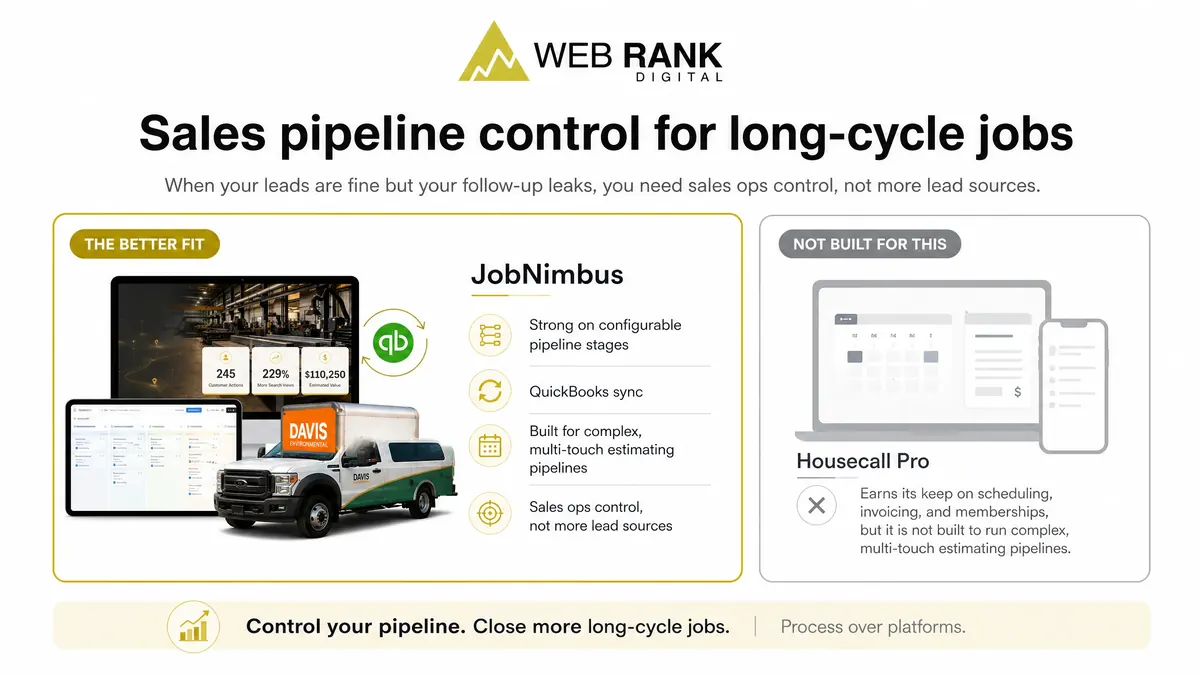
When your leads are fine but your follow-up leaks, you need sales ops control, not more lead sources. JobNimbus is strong on configurable pipeline stages and a QuickBooks sync. Housecall Pro earns its keep on scheduling, invoicing, and memberships, but it is not built to run complex, multi-touch estimating pipelines.
Pipeline stages that close deals
Long-cycle jobs close when your stages match how buyers decide, and every stage has an owner, a task, and a next date. That is the line between lead generation and sales operations: once the lead is captured, your process has to move it forward on purpose.
Define stages by job type. A reroof can be Lead -> Inspection Set -> Inspection Done -> Estimate Sent -> Decision Pending -> Closed. A remodel often needs Design Consult -> Scope Locked -> Proposal Revision -> Financing/Permit -> Closed, with more loops.
Then attach automation: reminders for site visits, and estimate follow-up sequences that keep momentum without you chasing from memory. Keep proposal flow tight: proposal sent triggers a task, and QuickBooks handoff happens only after signed approval so billing is clean.
- Minimum tasking per stage: next action, due date, responsible person
- Estimate sequence: day 1 confirmation, day 3 objections call, day 7 final decision ask
- QuickBooks and proposal flow: signed proposal -> job created -> deposit invoice queued
Local market visibility when you need more demand
Use Local Falcon to track grid rank across your real service area, not just at your office address. It shows exactly which neighborhoods see you in the map results and where you are invisible, so you can fix coverage without wasting spend.
What moves local demand now
When you need more leads without burning ad dollars, you win by capturing existing intent in the map pack. 2026 local search research found 93% of consumers search online before hiring a local contractor, and the top 20% capture 68% of local search visibility.
Google Business Profile signals still do the heavy lifting, but you should measure them by service area grid rank, not averages. That is how you avoid optimizing for the wrong ZIPs.
Visibility does not equal revenue. Map rankings must connect to a conversion system that answers fast and routes calls and forms correctly, or you just create more missed opportunities.
- Google Business Profile signals: primary category accuracy, consistent services, fresh photos, regular posts, and completed attributes
- Grid rank by service area: track by ZIP and neighborhood so you can prioritize where you can realistically win
- Review velocity and responses: steady new reviews plus timely owner replies that mention the specific service
- Service page and map pack synergy: one page per core service aligned to the same geography your profile targets
How do we prove the software is working within 30 days?
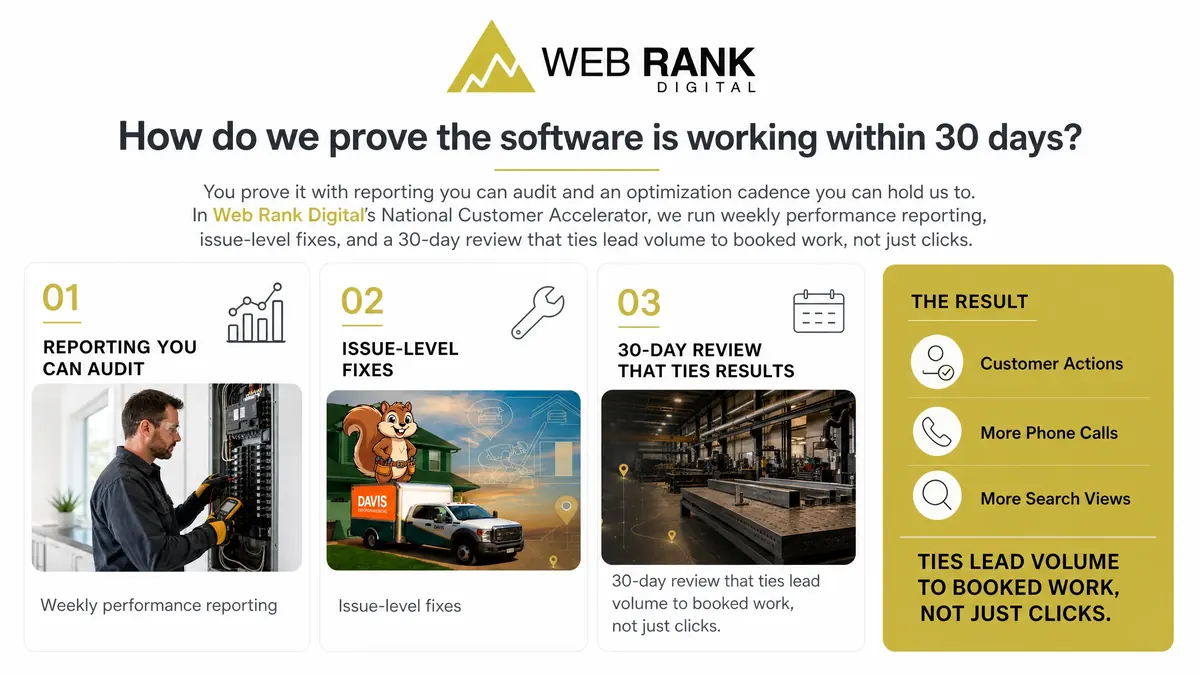
You prove it with reporting you can audit and an optimization cadence you can hold us to. In Web Rank Digital’s National Customer Accelerator, we run weekly performance reporting, issue-level fixes, and a 30-day review that ties lead volume to booked work, not just clicks.
The 30 day proof plan
Thirty days is enough to validate whether your acquisition engine is measurable and trending toward revenue. The trap is launching, then trying to “see what happened” without a baseline and clean attribution; SaaS adoption research flags this as the most common ROI measurement failure.
Week 0 is baseline week. We lock your current weekly averages for calls, form leads, and booked jobs so you are judging lift, not noise.
Days 1 to 7 are instrumentation. We install call tracking, form tracking, and source attribution so every lead is tied to a channel, campaign, and service area.
Days 8 to 30 are optimization. You watch leading indicators: contact rate (did you reach them) and booked rate (did it turn into scheduled work), then you decide with rules instead of opinions.
- Baseline: last 2 to 4 weeks of inbound calls, form submissions, and booked jobs by location and job type
- Instrumentation: unique tracking numbers, tagged forms, and a single attribution view inside the Performance Dashboard and Analytics
- Leading indicators: contact rate and booked rate by channel and service area
- Decision rules: scale budget and workflows when booked rate improves week over week; cut or re-target channels that cannot be attributed or do not produce booked jobs by day 30
Prove ROI in 30 days, then scale what converts
If you are tired of shared leads and untraceable spend, the next step is not another directory. You need market intelligence by ZIP, one trackable funnel, and clean lead-to-booked-job reporting so you can make decisions fast.
That is exactly how we deploy National Customer Accelerator at Web Rank Digital. We start with a market and competitor analysis across your service ZIPs, then configure lead capture and customer acquisition workflow automation to protect speed-to-lead. You get performance reporting you can use, including calls, forms, and booked jobs.
Book a National Customer Accelerator demo with us. Bring your top job types and your service area list. We will map where you can win, launch one location first with onboarding and an account manager, then review your first 30 days metrics to decide what to scale.
Frequently Asked Questions
What is lead generation software for contractors?
It is software designed to help you win new customers by combining service area market intelligence with lead capture and automated customer acquisition workflows. The goal is measurable performance from first contact through booked jobs, not just a bigger lead list.
How is lead generation software different from a CRM?
Lead generation software focuses on identifying demand, capturing new leads, and converting them with automated follow-up and tracking. A CRM manages customers and relationships after the lead is already won.
Can lead generation software work for multi-location contractors?
Yes, if the platform supports multi-location management and reporting by territory so you can scale without losing visibility. National Customer Accelerator offers licensing that can expand by seats and locations as you prove one market first.