
The best competitor intelligence software for helping your local business beat nearby competitors is a competitor intelligence platform that turns keyword gap analysis and heatmap tracking into weekly map pack actions.
Here’s what matters most when you are choosing a churn-focused competitor intelligence platform:
- Start with competitor discovery by service area, not a national competitor list.
- Prioritize keyword gap analysis tied to high-intent local terms you can act on.
- Use service area heatmaps to spot where competitors dominate the map pack.
- Require real-time monitoring and alerts, so you respond within days, not quarters.
- Choose built-in playbooks that convert findings into GBP, page, and local link tasks.
- Set ethical boundaries and only use public, permissioned sources for research.
At National Customer Accelerator, we built our Competitor Analysis System to do the part most local teams get stuck on: turning monitoring into execution. You can see competitor rankings, backlink tracking signals, and map pack heatmap visualization in one place, then use an actionable playbook generator to produce clear tasks. If you want implementation support, we can also execute through our Local SEO by WRD service, using the same competitive rank audits and gap detection to guide weekly priorities. Next, let’s get specific about the marketing signals that predict local churn early, so you can choose software based on whether it actually helps you stop losing customers to competitors.
What marketing tool helps when my business is losing customers to competitors?
Signals that predict churn locally
When you are losing customers locally, the most useful “tool” is a monitoring stack that shows churn risk signals before revenue drops show up in your books. You are looking for changes competitors trigger in visibility, trust, and speed of response.
Focus on signals that move the map pack and customer choice week to week:
- GBP rank drops by neighborhood: you may still rank in your office ZIP code but disappear a mile away where calls are actually coming from
- Review velocity and rating shifts: a competitor adding fresh reviews weekly, or your average rating sliding after a small batch of negatives, changes click and call behavior fast
- Offer changes and pricing cues: new “same-day” offers, financing language, or visible price anchors can reset what shoppers expect before they contact you
- Response time and messaging gaps: slow replies to calls, messages, and Q&A give competitors the first live conversation, which usually wins the booking
Four tool categories that matter
You do not need more dashboards. You need four software categories that capture those local churn signals and make them easy to act on with a small team:
Used together, they show where you are slipping, why customers are choosing someone else, and what to fix first.
- Local SEO geo grids: neighborhood-level visibility tracking so you can see map pack losses by block, not just “citywide” averages
- Reputation and review platforms: consolidate review monitoring and response workflows so velocity and rating changes do not go unmanaged
- Social listening and publishing: track competitor promos and customer complaints, then publish updates fast enough to stay relevant
- Voice of customer analytics: turn calls, forms, surveys, and feedback into churn themes you can quantify and prioritize, not anecdotes
Our churn defense scoring rubric for competitor intelligence
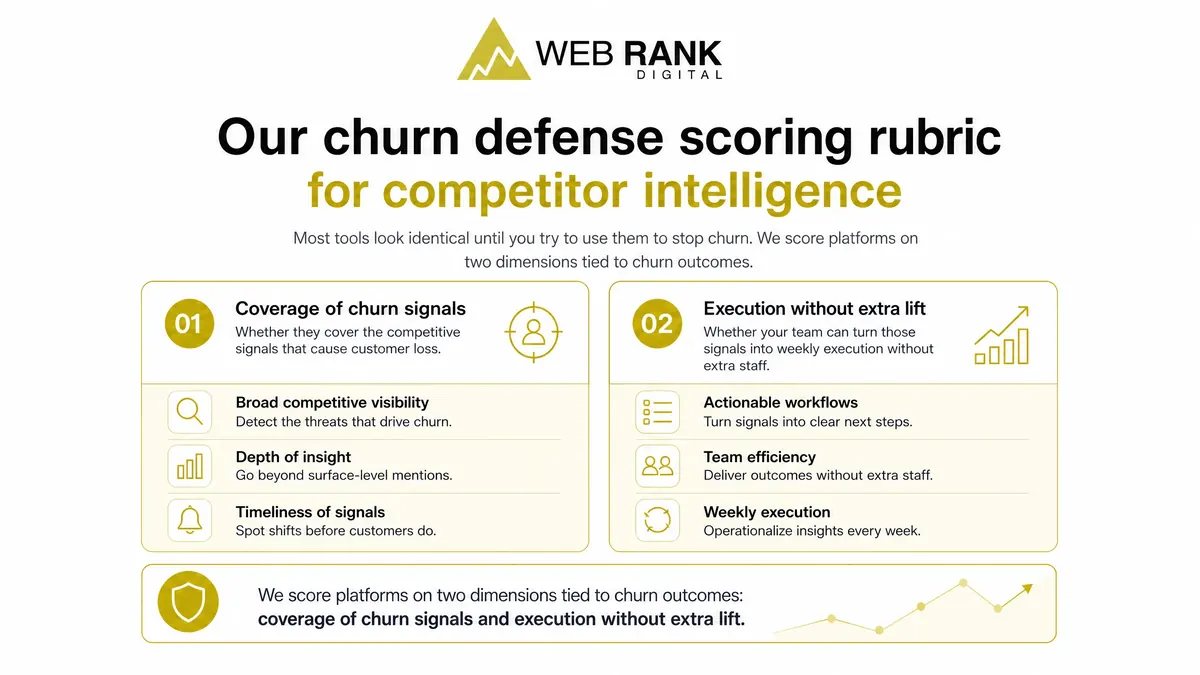
Most tools look identical until you try to use them to stop churn. We score platforms on two dimensions tied to churn outcomes: whether they cover the competitive signals that cause customer loss, and whether your team can turn those signals into weekly execution without extra staff.
Churn Coverage Score
Churn Coverage Score measures whether the platform detects the competitor moves that pull high-intent local customers away, early enough to respond.
You score it by checking for four signal types that map to local revenue: rankings, reviews, offers/content, and alerting that reflects lead volume risk, not vanity metrics.
- Rank share of voice tracking: competitor geo-ranking across your service area, not a single city-wide average
- Review theme extraction quality: clusters that separate service-line issues (speed, pricing, outcomes) from generic sentiment
- Offer and content monitoring: changes to service pages, new location pages, pricing/financing, and proof assets that shift conversion
- Alerts tied to revenue proxies: triggers aligned to calls, form fills, direction requests, and map-pack visibility drops in priority grids
Actionability Score
Actionability Score tells you whether insights become assigned work this week, or sit in a dashboard until the next monthly meeting.
We look for operational plumbing: can you route a competitor finding to an owner, push context into your CRM, and ship a weekly cadence across one or many locations?
- Owner assignment and workflows: tasks, due dates, and approvals tied to specific competitor events
- Integration with CRM and email: alerts and notes that land where sales and ops already work
- Reporting cadence weekly ready: a digest that supports a consistent Monday plan of record
- Multi-location rollups supported: franchise and branch-level views without losing market-specific detail
Best market intelligence tool for finding untapped local opportunities
What counts as an untapped area
Untapped local opportunity is not “cheaper pricing.” It is measurable demand with weak local coverage, where you can win by changing what shows up in the map pack and on service pages.
We define it using four signals your market intelligence tool must surface clearly, not bury in charts:
- High intent searches, low coverage: “near me” and service-plus-city terms where few competitors have relevant pages or strong map pack presence
- Weak competitor review themes: recurring complaints in review text (missed appointments, slow response, poor cleanup) that you can operationalize and then highlight in your positioning
- Map pack gaps by neighborhood: grid cells where the top 3 results rotate frequently or show low review volume, indicating no dominant provider
- Service demand mismatched offers: consistent searches for a specific job (urgent, same-day, niche repair) but competitors push generic service menus and thin FAQs
Data sources that reveal whitespace
The best market intelligence tool for local whitespace combines geo-ranking visibility with proof of what customers actually ask for and complain about. That is how you escape the price trap: you compete on clarity and fit, not discounts.
Prioritize tools that pull these inputs into one workflow:
- Geo grid rank and density: heatmap tracking that shows where you and competitors win or disappear street by street
- Review text and categories: keyworded themes inside reviews plus the GBP categories competitors rely on to rank
- Social posts and ads signals: repeated offer language, seasonal pushes, and urgency angles competitors pay to amplify
- Website content gaps versus rivals: service pages and FAQs they rank with that you do not have, or that you have but under-specify
Quick picks: the best options by churn situation
Web Rank Digital
Pick this when churn is driven by local competitors taking map-pack share and you need a weekly action plan, not another dashboard.
Our National Customer Accelerator operationalizes churn response into weekly churn actions, with done-with-you deployment support so your team ships changes fast. You also get cross channel competitor monitoring and multi-location reporting workflows that keep franchises and teams aligned.
Birdeye
Choose Birdeye when churn shows up as review loss, slow responses, or inconsistent customer experience across locations.
It is built for review generation and responses, messaging and customer experience, and reputation reporting for teams. It is especially strong when you manage high review volume and need a single operational workflow.
Local Falcon
Local Falcon fits when you need to prove location visibility shifts in Google Maps, fast.
You get geo grid Google Maps rankings with visual share of voice maps, which is good for diagnosing where you are visible and where competitors dominate. It is best when you need rank movement proof for specific neighborhoods.
ActiveCampaign
ActiveCampaign is the pick when churn is lifecycle-driven and you need automation to pull customers back.
Its strength is automation and lifecycle campaigns, including winback sequences for churn, with a strong integrations ecosystem. The tradeoff is limited competitor visibility native, so you pair it with a competitive system when local rivals are the root issue.
Klaviyo
Klaviyo is best when churn looks like fewer repeat purchases in ecommerce.
It focuses on ecommerce retention automation, with segmentation and attribution tools that support repeat purchase flows. It is not local competitor focused, so it will not answer why you lost share in a service area.
Mailchimp
Mailchimp works when you need reliable email basics without heavy setup.
You get templates plus simple audiences and journeys that small teams can run. Expect minimal competitor intelligence, so it will not identify local gaps or rival movements.
Hootsuite
Use Hootsuite when churn risk is tied to inconsistent social publishing and slow comment or DM handling.
It covers social scheduling and monitoring, an inbox and engagement workflow, and team approvals and governance. It is not built for local rank intel, so it will not explain map-pack losses.
Enterpret
Enterpret fits when churn is a feedback problem and you need to understand why customers leave at scale.
It provides voice of customer analytics with theme clustering across feedback, which is good for product insights and service issue prioritization. It requires input data sources, so you need to pipe in reviews, tickets, surveys, and call notes to get value.
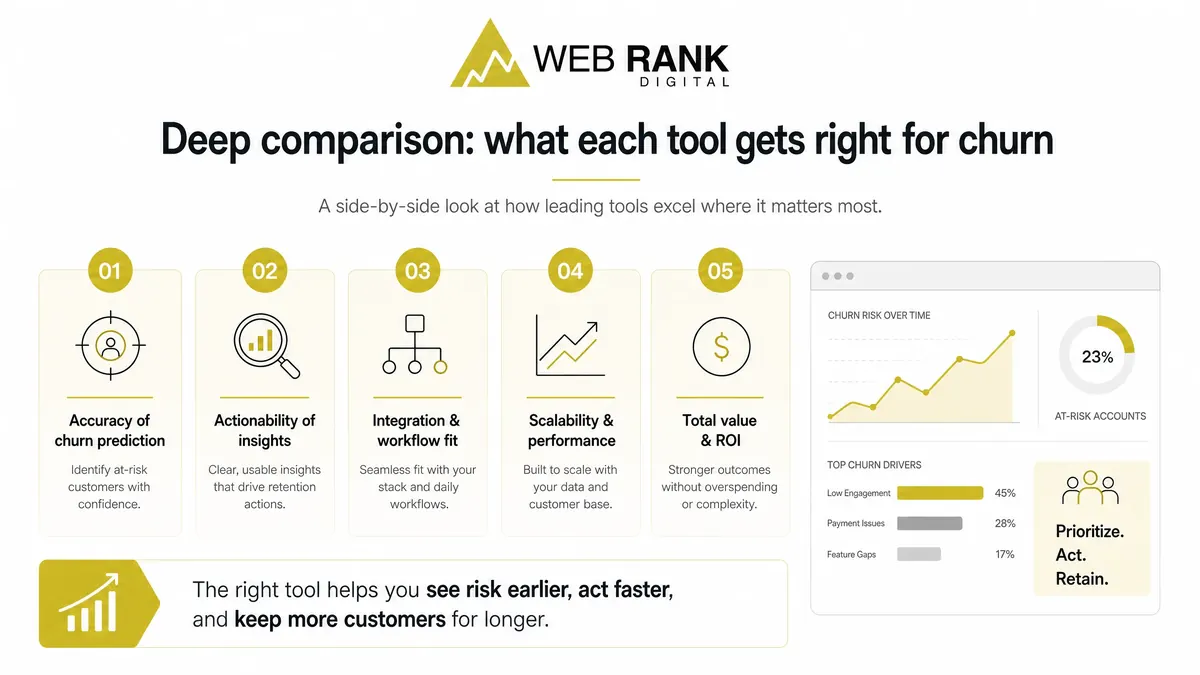
Deep comparison: what each tool gets right for churn
Where Birdeye beats most stacks
Birdeye earns its keep when churn is being driven by trust decay and unanswered customer friction. You get tight review capture and response workflows across 200+ sites, so you can reduce silent dissatisfaction before it turns into lost calls.
It is also strong on consolidating CX messaging in one place, which matters when multiple locations or teams create inconsistent customer communication.
For reputation programs, the reporting is built for operational rollout: you can track volume, velocity, and response performance without stitching together exports.
The tradeoff: it improves social proof fast, but it does not tell you which local competitors are taking map pack share in specific neighborhoods.
Where Local Falcon is strongest
Local Falcon is the clearest tool for proving map pack visibility changes at a granular level. The geo-grid view shows exactly where you rank, not just an average position.
You can capture before-after ranking evidence and use it to validate whether a GBP or page change actually moved the needle in specific zones.
This is where neighborhood targeting decisions get rational: you stop guessing which parts of town you can win.
It also surfaces competitive proximity insights by showing where nearby competitors dominate your service area.
Where Web Rank Digital leads
Web Rank Digital leads when churn is caused by “we saw the data, but nothing changed this week.” Our National Customer Accelerator is built around execution cadence, so insights convert into a weekly queue your team can actually complete.
You are not stuck with generic recommendations. Our playbooks are tied to churn drivers like lost map pack coverage, missed high-intent keywords, and competitor backlink gaps.
The difference is multi-signal intelligence into actions: real-time monitoring, gap detection, keyword ranking comparison, and heatmap visualization feeding an actionable playbook generator inside our Competitor Analysis System.
You can keep it internal, or we can own consult, deploy, optimize through Local SEO by WRD. Schedule a National Customer Accelerator demo and ask for a Competitor Analysis System walkthrough with a heatmap and keyword gap sample for your market.
How we deploy competitor intelligence without adding busywork
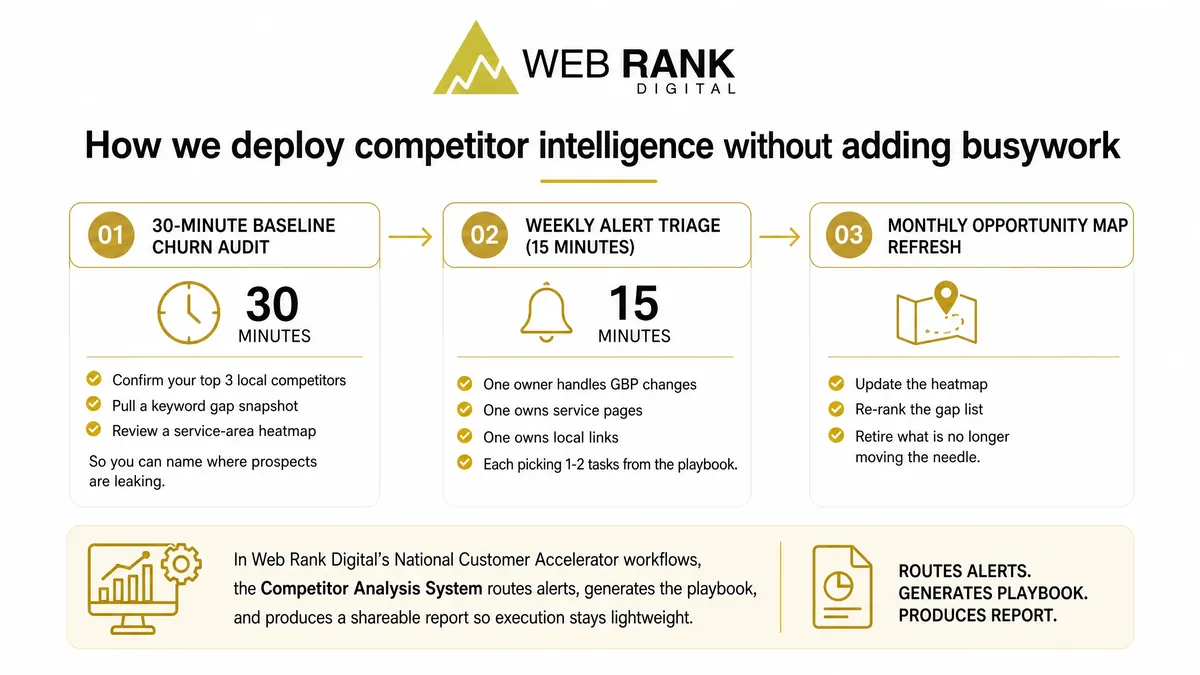
You do not need another tool to manage. You need a tight operating rhythm that turns competitor signals into owned actions. Our 30-minute baseline churn audit is a single working session: confirm your top 3 local competitors, pull a keyword gap snapshot, and review a service-area heatmap so you can name where prospects are leaking.
From there, weekly alert triage takes 15 minutes. One owner handles GBP changes, one owns service pages, and one owns local links, each picking 1-2 tasks from the playbook. Monthly, you refresh the opportunity map: update the heatmap, re-rank the gap list, and retire what is no longer moving the needle. In Web Rank Digital‘s National Customer Accelerator workflows, the Competitor Analysis System routes alerts, generates the playbook, and produces a shareable report so execution stays lightweight. Book a demo and ask for a walkthrough with a heatmap and keyword-gap sample.
Turn competitor movement into a weekly churn defense plan
If you want to stop losing nearby customers, you need more than a dashboard. You need a weekly playbook tied to what is changing in your map pack and service areas right now. That is exactly how we use the National Customer Accelerator, with the Competitor Analysis System as the execution hub.
In your demo, we will walk you through your market using Heatmap Visualization and Keyword Ranking Comparison, then pinpoint the gaps with our Gap Detection Engine. You will leave with a prioritized set of actions you can assign this week across your Google Business Profile, service pages, and local links.
Request a National Customer Accelerator demo with Web Rank Digital and ask for a Competitor Analysis System walkthrough, including a heatmap and keyword gap sample report. If you want hands-on implementation, start onboarding with an account manager this week for Local SEO by WRD.
Frequently Asked Questions
How is Competitor Intelligence Software different from a rank tracker?
A rank tracker mainly reports where you rank. Competitor intelligence shows where competitors are winning, where you are missing coverage, and what changed, so you can act on gaps instead of watching positions move.
What does ‘gap detection’ mean in competitor intelligence?
Gap detection is the system process for identifying where competitors have an advantage that you can realistically close, such as missing high-intent keywords, thin or absent service pages, weak local link coverage, or poor visibility in specific neighborhoods.
How often does competitor intelligence software update its data?
It depends on the platform. With real-time monitoring, you can see competitor changes within hours and set alerts, then choose a practical cadence for your team, typically weekly for action and monthly for trend validation.