
The best automated lead funnel software for your business is the one you can launch in days without breaking lead routing, while still giving you touchpoint level revenue tracking.
Here is what matters most when you choose and deploy lead funnel software:
- You need a 5-stage always-on flow: capture, segment, nurture, handoff, and revenue tracking.
- 24/7 performance comes from behavioral trigger workflows that fire on real intent signals.
- Automation breaks when form fields, tags, and event naming drift out of consistency.
- The minimum stack is fewer systems, plus integrations you can validate in a live demo.
- A real demo shows prebuilt funnel templates, intent-based segmentation, and attribution per touchpoint.
- Lock-in risk drops when you can export data and run routing in parallel during migration.
At Web Rank Digital, we built National Customer Accelerator to solve the exact failure point you have seen before: buying another tool that never goes live cleanly. With 15+ years in customer acquisition and 1,000+ clients supported, we focus on guided deployment with prebuilt industry-specific journey templates, smart segmentation, built-in A-B testing, and a conversion attribution system you can tie back to revenue. Before you compare vendors, get clear on what “24/7” actually looks like inside the platform, minute by minute, from first capture through handoff and attribution. That practical view is what reveals whether the software will run while you are offline or just create another dashboard to babysit.
What does 24-7 automated lead funnel software do in practice?
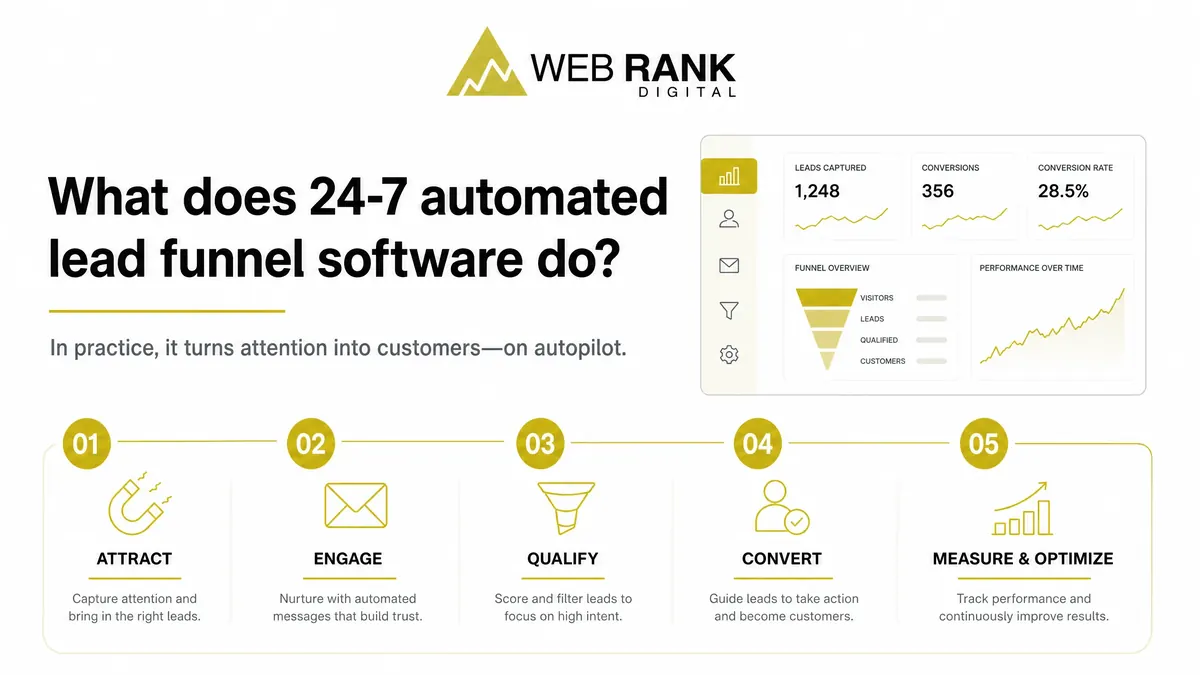
The 5-stage always-on funnel
In practice, a 24-7 automated lead funnel runs the same way at 2 p.m. and 2 a.m.: it captures an inquiry, decides what it is, and starts follow-up without waiting on a person. If you still have to “check the inbox” before anything happens, it is not always-on.
Your operational target is speed-to-lead under 5 minutes. Harvard Business Review research found the odds of qualifying a lead are 21 times higher when contacted within 5 minutes compared to 30 minutes after an inquiry.
The work is executed across channels, not trapped in one.
- Capture: forms, chat, call tracking, or bookings create a lead record
- Qualify: required fields and behavior signals flag fit and urgency
- Route: the right rep, location, or pipeline gets assigned automatically
- Nurture: sequenced email, SMS, and calls continue until a conversion event
- Handoff: when intent is high, it creates a task and context for a human follow-up
Automation versus glorified templates
Real automation is triggered workflows, not one-time broadcasts you have to remember to send. A lead action kicks off the next step, and the system keeps moving until a stop condition is met.
You should see conditional logic by intent: different paths for demo-ready, price-shopping, and low-fit inquiries. If everyone gets the same sequence, you did not remove manual work, you just packaged it.
Two-way CRM writeback is non-negotiable. The funnel must both read CRM status and push updates back (stage, owner, outcomes), or your team will still re-enter data and chase ghosts.
- Triggered: form submit, page intent, missed call, or booking starts the journey
- Conditional: rules change touches, timing, and routing based on intent signals
- Writeback: updates flow to and from the CRM so automation and sales stay in sync
How does it keep working when you are offline?
Triggers that fire 24-7
It keeps running because the “work” happens in the platform, not in your inbox. Triggers listen for specific events and launch the next step instantly, even at 2 a.m.
The core events are straightforward: form submits and chat events create a new lead record, then the system stamps the lead source at capture using UTM parameters so attribution does not rely on manual notes later. It also watches behavior signals, like key pages viewed, link clicks, and email replies, so your follow-up changes based on what the prospect actually did, not what you hope they did.
Routing rules that prevent leakage
Offline is where most funnels leak: the lead arrives, but no one owns it. Routing rules prevent that by assigning every lead to a human or queue the moment the trigger fires.
In practice, you route by territory, service line, and deal size so the right team gets the right opportunities. You can also run round robin assignments, with capacity caps to avoid dumping 30 leads on one rep while others sit idle.
The last safeguard is operational: a fallback owner plus an escalation path, so unworked leads do not disappear into a shared inbox. This is why integrations and monitoring matter later, because routing is only as reliable as the systems it hands off to.
Why do most automated funnels still need manual work?
Data hygiene breaks automation
Automation is only as “hands-off” as your underlying records. When your database is messy, your team ends up manually fixing routing, attribution, and follow-up that should have run 24/7.
The most common breakpoints we see are straightforward:
- Duplicate contacts and missed merges: the same person enters twice, so they get double outreach or get routed to the wrong owner.
- Missing required fields: triggers fail because the record never qualifies for segmentation or handoff rules.
- Inconsistent lifecycle stages: reporting and workflows disagree on whether someone is a lead, MQL, SQL, or customer, so automation fires at the wrong moment.
CRM data quality studies report 37 percent of CRM users have lost revenue because of unreliable data, which is exactly how “automation” turns into babysitting.
Integrations that do not write back
Even with clean records, funnels need manual work when connected systems only push data one way. You capture intent in one place, but the source of truth never gets updated, so teams reconcile by hand.
Watch for these integration failure modes:
- One-way sync limitations: status updates, ownership, or outcomes never return to the system running the journey.
- Webhooks versus file exports: webhooks can update near real time; exports create batch delays and missed triggers.
- Field mapping drift over time: new fields get added, renamed, or repurposed, and silently stop matching across tools.
The minimum stack for a hands-off lead funnel
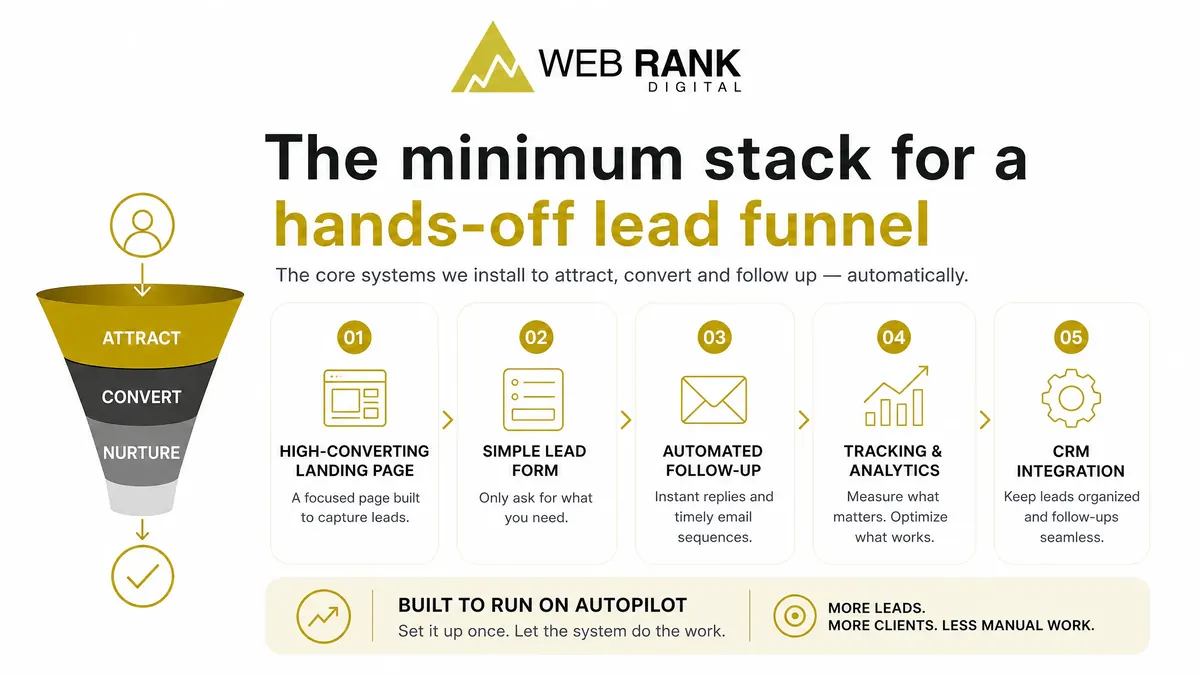
Core systems and must-have features
The wrong stack is the one that cannot route, follow up, and book without human glue. You only need three systems, but they must behave like one.
Buy for outcomes: every lead lands in a CRM record, enters an automated journey, and can self-book into a real calendar slot. If any step requires copy-paste, your 24/7 funnel breaks at volume.
- CRM: clean lead record, activity history, owner assignment, and field-level segmentation inputs
- Automation engine: behavioral triggers, branching journeys, and a single source of truth for touchpoint attribution
- Scheduler: round-robin or rules-based booking, confirmations, and no-show reduction
- Inbox and calling integration: logged replies, call outcomes, and one thread per lead
- Lead scoring and segmentation: intent rules (behavior, channel), plus “ready for sales” thresholds
Monitoring and failure recovery
Automation is only hands-off if you can detect failure fast and auto-recover. You are buying downtime prevention, not dashboards.
- SLA timers and alerts: notify when a lead has not been touched, routed, or booked within your response window
- Bounce, spam, deliverability checks: suppress bad addresses, watch spam signals, and quarantine risky sends
- Queue retries and error logs: automatic replays for transient failures, plus a clear log showing which step failed and why
How we deploy 24-7 automation with National Customer Accelerator
Week-by-week setup timeline
You do not prove 24-7 automation in a slide deck. You prove it by getting one funnel live without breaking routing, then watching it run unattended.
Our implementation layer is National Customer Accelerator, because its prebuilt funnel templates, Smart Segmentation Engine, and Conversion Attribution System reduce custom build risk.
- Week 1: audit your current lead-to-customer conversion pipeline and map every entry point, delay, and handoff so routing parity is documented before any changes
- Week 2: build behavioral trigger workflows, segmentation rules by channel and intent, and handoff routing so the right team gets the right lead with context
- Week 3: QA the full journey, set monitoring on key steps, run a controlled go-live, and validate attribution touchpoints in the Revenue Dashboard
Proof you can measure fast
Real-world performance shows up in three numbers you can review in days, not quarters. That is how you separate “automation that runs” from “automation that exists.”
- Response time: track median and p95 from first inquiry to first meaningful touch, because outliers usually indicate routing or notification failures; Harvard Business Review research ties faster contact to higher qualification odds
- Appointment rate by source: measure bookings (or demo requests) by channel so you can keep spend where the funnel converts, not where clicks look good
- Handoff acceptance rate: quantify how often sales or ops accepts the automated handoff, since rejected handoffs are the earliest signal your rules or qualification gates need adjustment
What ROI should you expect from 24-7 follow-up?
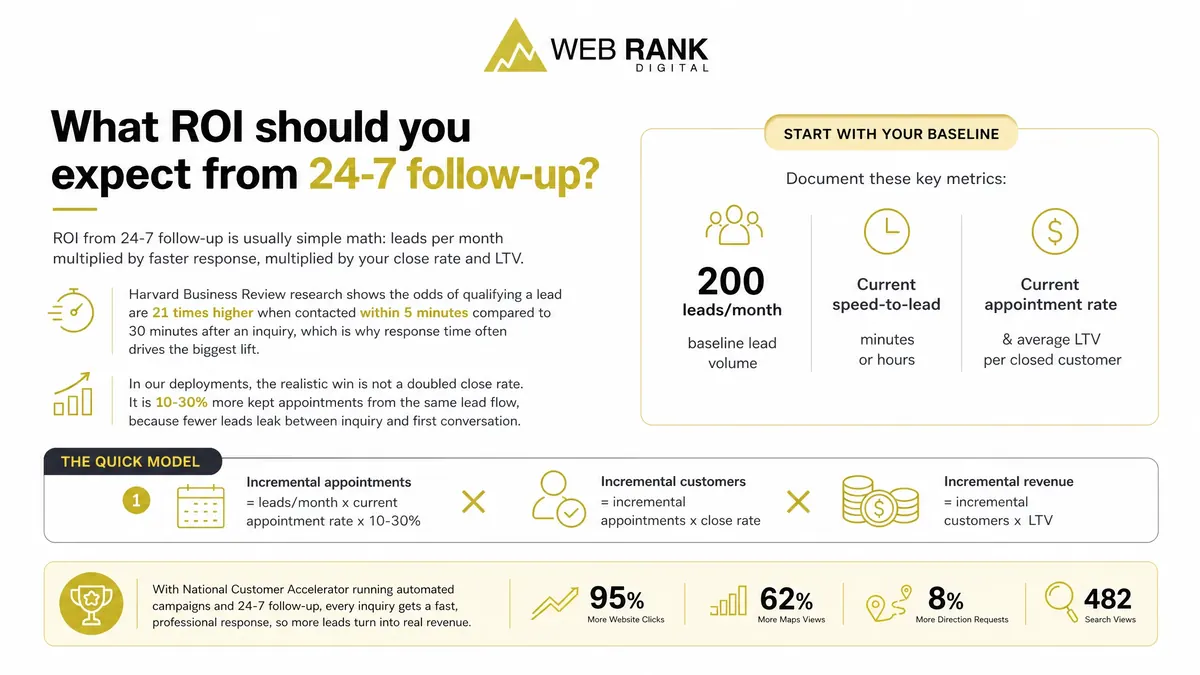
ROI from 24-7 follow-up is usually simple math: leads per month multiplied by faster response, multiplied by your close rate and LTV. Start with your baseline lead volume (say 200 leads/month) and document current speed-to-lead (minutes or hours), current appointment rate, and your average LTV per closed customer. Harvard Business Review research shows the odds of qualifying a lead are 21 times higher when contacted within 5 minutes compared to 30 minutes after an inquiry, which is why response time often drives the biggest lift.
In our deployments, the realistic win is not a doubled close rate. It is 10-30% more kept appointments from the same lead flow, because fewer leads leak between inquiry and first conversation.
Use this quick model:
- Incremental appointments = leads/month x current appointment rate x 10-30%
- Incremental customers = incremental appointments x close rate
- Incremental revenue = incremental customers x LTV
With National Customer Accelerator running automated customer journeys and attribution, payback is typically 30-90 days, and any week you wait is measurable leakage you can see in your response-time report.
Launch one funnel this week and prove attribution in week one
If you are worried you will buy another tool that never gets implemented, or you will break lead routing during migration, you are not alone. That is where most automated funnels fail, not on features, but on deployment and measurement.
With National Customer Accelerator, we take you through a repeatable path: a scoped discovery to confirm your routing rules and integrations, guided deployment using prebuilt funnel templates, then optimization using the A-B testing module and conversion attribution system so you can see touchpoint level impact in the revenue dashboard.
Book a demo with Web Rank Digital. Come ready to pick your industry template set and confirm an integration and migration plan with your account manager. Then we will launch one funnel and review attribution in week one.
Frequently Asked Questions
How quickly can I launch an automated funnel?
If you start with prebuilt funnel templates and keep the first journey focused on one offer and one handoff, you can typically launch in days instead of spending weeks building from scratch. In your demo, we will map what is required for your specific integrations and routing rules so the timeline is realistic.
How does revenue attribution work in the funnel?
National Customer Accelerator tracks key touchpoints across your automated customer journey and ties them to conversions so you can see which steps are creating pipeline, not just clicks. You review that performance in the revenue dashboard so optimization is based on measurable lift.
Can I use different funnel templates for different business models?
Yes. You can deploy different prebuilt funnel templates for lead generation, trial-to-paid flows, demo requests, cart recovery, and service scheduling, then tailor paths with the smart segmentation engine. That lets you match automation to intent without rebuilding every funnel from zero.