The best PPC management tool for a local service business is the one that proves which ads and keywords turn into booked jobs, not just clicks and leads. If you cannot tie spend to calls, appointments, and follow up, you are optimizing blind, even with “clean” dashboards.
Here is what matters most when you choose a PPC management tool for a local service business:
- Lead-to-booking attribution is non-negotiable if you want to cut waste confidently.
- Local targeting support matters because performance changes block by block.
- Call and form capture must feed an automated funnel or leads decay fast.
- Competitor and market intelligence prevents you from bidding blind in saturated ZIPs.
- Guided optimization with onboarding plus an account manager beats DIY tools under pressure.
- Tool types fall into three buckets: standalone platforms, agency-only management, and all-in-one systems.
At Web Rank Digital, we built the National Customer Accelerator for the exact failure point you are seeing: PPC reporting that cannot connect ad spend to booked work. Our platform pairs funnels with our Market Intelligence Engine and Competitor Analysis System, so you can see what is working, what is leaking, and what your local competitors are doing before you scale. We will start with National Customer Accelerator because it is the only category here designed to combine PPC, funnel follow up, and competitor intel in one operating system, with onboarding support to keep it from stalling in week two.
1. Web Rank Digital National Customer Accelerator
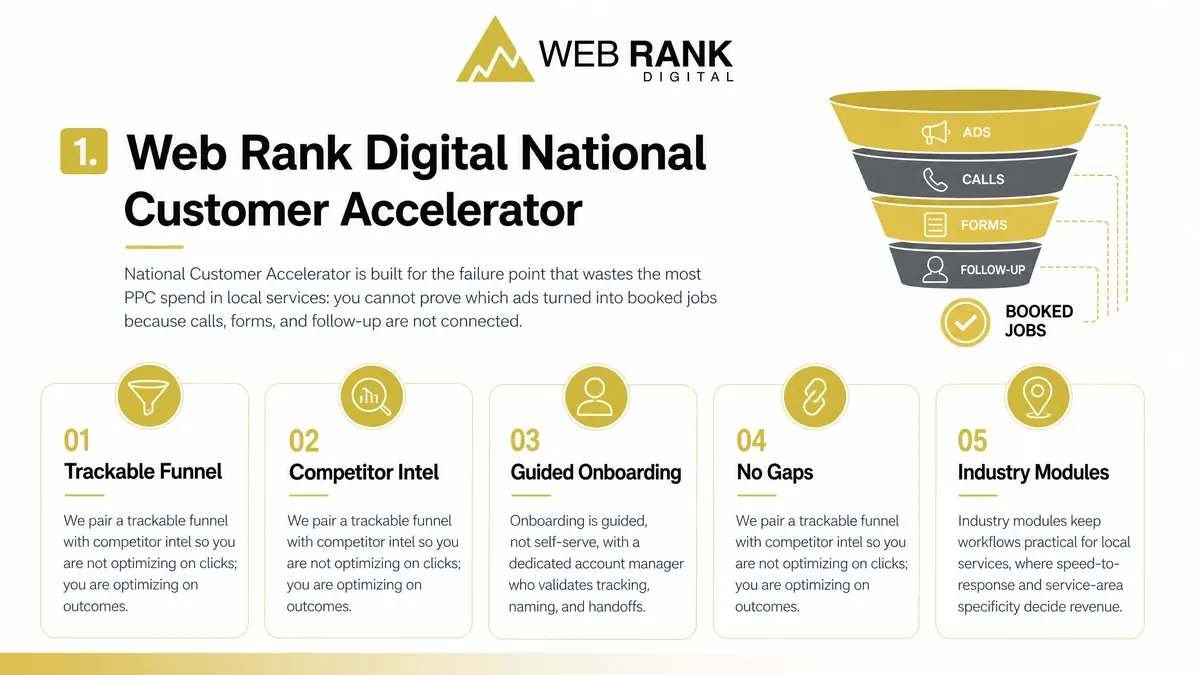
National Customer Accelerator is built for the failure point that wastes the most PPC spend in local services: you cannot prove which ads turned into booked jobs because calls, forms, and follow-up are not connected. We pair a trackable funnel with competitor intel so you are not optimizing on clicks; you are optimizing on outcomes. Onboarding is guided, not self-serve, with a dedicated account manager who validates tracking, naming, and handoffs so calls do not disappear in the gaps.
Industry modules keep workflows practical for local services, where speed-to-response and service-area specificity decide revenue.
2. Local Falcon
Local Falcon is for local rank tracking, not PPC management. It shows you how your Google Business Profile ranks on Maps across a geo grid, so you can see visibility block by block instead of relying on a single “average” position. That makes it useful for monitoring map visibility shifts after listing updates, reviews, category changes, or nearby competition moves.
What it will not do is run ads, manage bids, or prove which campaigns turned into booked jobs.
3. Optmyzr
Optmyzr is a hands-on Google Ads optimization platform built for speed once your conversion tracking is already clean. You use rule-based optimizations and scripts to standardize the work you would otherwise do manually, like pausing waste, surfacing anomalies, and tightening budgets and bids across accounts. The tradeoff is discipline: if your conversion actions, naming, and lead quality signals are messy, you will automate the wrong decisions faster.
It also does less for follow up workflows, so nurturing, routing, and booked-job tracking still need a separate system.
4. WordStream
WordStream is built for small teams that need Google Ads and Microsoft Ads workflows simplified, not a deep attribution lab. You typically get a more guided experience: centralized account views, faster cleanup of obvious issues, and recommended optimizations you can apply without living inside each ad platform.
The risk, if you are trying to prove booked jobs, is reporting that stops at leads or platform conversions. Plan on separate call tracking if phone calls drive revenue, or you will still be guessing which keywords and ads created real appointments.
5. AdEspresso by Hootsuite
AdEspresso by Hootsuite is a paid social management tool first, so it fits best when Facebook and Instagram are meaningful lead sources in your local mix. Where it helps is creative and testing discipline: you can structure variations, compare performance cleanly, and keep iteration moving without spreadsheet drift. Where it does not help is proving call-to-booking for local service work; you will still need separate call tracking and CRM follow-up to connect Meta leads and calls to scheduled jobs, and it will not solve Google Ads call attribution.
6. Acquisio
Acquisio is built for automation-first PPC management when you are running many locations, many services, or many client accounts with a lean team. You use it to standardize changes at scale, reduce manual bid and budget work, and keep day-to-day management from turning into spreadsheet operations across dozens of campaigns.
Where teams get tripped up is attribution. What you can prove about booked jobs versus leads depends on how your call tracking, form capture, CRM, and offline conversion imports are set up. Without that plumbing, automation can still improve efficiency, but ROI stays partially inferred.
7. Clicks Geek
Clicks Geek represents the done-for-you route: you hand campaign buildout, budget pacing, and ongoing optimization to an agency so you are buying execution, not software controls. This is a strong fit when you are time constrained and you cannot afford weekly ad account babysitting, but you still need your phones to ring consistently. To protect against “missing calls” and reporting noise, ask for call tracking proof before you commit: a live example of call recordings, call timestamps tied to ads and keywords, and a clear method for filtering spam and repeat callers.
8. Hibu
Hibu is a bundled marketing provider, meaning you can get ad management packaged with other execution work, which is attractive when you want one vendor and minimal internal lift. The tradeoff is transparency: bundled reporting can drift into clicks, impressions, and “leads” without proving which campaigns produced booked jobs. Before you commit, require booked-job clarity: which calls or forms were qualified, which turned into scheduled work, and what revenue you can attribute back to spend, not just activity reports.
9. WebFX
WebFX is the larger-agency option when you want process, bench strength, and the ability to run multi-channel programs without rebuilding the playbook every quarter. You can expect full-service coverage across paid search, landing pages, SEO, content, creative, and analytics, plus specialists who can support reporting and testing at scale.
For a local service operator, the non-negotiable is proving the lead-to-booked-job loop. Require tracking that ties each call or form to a qualified opportunity, an estimate, and a booked job, so you can judge lead quality, not lead volume.
10. Disruptive Advertising
Disruptive Advertising is a performance agency option when you want PPC management owned end to end, not just platform recommendations. You are typically paying for tighter measurement discipline and follow-through: converting spend into actions you can optimize against, then iterating fast. The testing loop matters, but only if you keep your funnel clean.
If your call tracking, form capture, lead routing, and sales follow-up are inconsistent, the best campaign work still optimizes to noise, not booked jobs.
11. Directive
Directive is typically evaluated when you want a structured paid media program instead of ad hoc campaign management. You are buying a defined process for building, launching, and optimizing campaigns with consistent reporting, which matters when spend and lead flow need control.
This model tends to fit better when your offer is complex, your buying cycle is longer, or your average ticket is higher, because the program can support tighter targeting, message discipline, and conversion tracking across multiple decision steps.
Before you commit, confirm they are set up to execute local service area work, not just broad geo targeting, and that your ZIPs, exclusions, and job-type coverage are handled with precision.
12. JumpFly
JumpFly is an agency option built around PPC execution: building campaigns, managing bids and budgets, and running the day-to-day optimizations that keep spend from drifting. That can take real load off your team, especially when you do not have time to monitor search terms, ads, and pacing daily. The fair test is attribution: execution alone will not fix a tracking gap.
Before you switch managers, audit call tracking coverage: confirm every number is tracked, forwarded correctly, and tied back to the campaign and keyword that drove the call.
13. Fiverr Pro PPC Services
Fiverr Pro is the cheapest common route because you can buy PPC talent as a one-off deliverable instead of committing to a platform or retainer. It can work when you need an isolated build: account cleanup, new campaign structure, ad copy refresh, or a landing page audit. Where it breaks for local lead quality is ongoing accountability.
You often inherit tracking gaps, like no clean call attribution, inconsistent form routing, or conversions that do not map to booked jobs, so optimization turns into guesswork.
How to choose a PPC tool when booked jobs are the goal
The Booked Job Proof Score
Pick the tool that can prove spend to revenue, not spend to leads. Your minimum bar is a Booked Job Proof Score: the system must show which campaigns create booked appointments and completed jobs.
- Calls and forms push into your CRM automatically, with the original ad and keyword attached
- Appointments and job outcomes are captured as fields (scheduled, showed, sold, completed, revenue)
- You can report cost per booked job, not just cost per lead
- One source of truth reporting ties ad spend, lead, appointment, and job outcome in the same view
What to bring to onboarding
Switching tools without losing leads comes down to clean inputs on day one. In our National Customer Accelerator demos, we move faster when you bring the specifics below.
- Your top three services to sell (the jobs you want more of, not every service you offer)
- Your priority service areas and zip codes
- Your last 90 days of PPC exports (campaigns, keywords, ads, spend, conversions)
- Call logs and missed calls so you can fix response gaps before you scale spend
Stop Paying to Guess Which PPC Clicks Become Booked Jobs
If your current setup cannot connect ad spend to calls, appointments, and follow up, you are optimizing on noise. You do not need more dashboards. You need booked job proof with tracking that holds up when leads move from click to conversation to scheduled work.
That is what we built Web Rank Digital National Customer Accelerator for. You get competitor and market intelligence, an automated funnel tied to PPC traffic, and onboarding with a dedicated account manager who owns optimization and reporting, so you can see what is producing revenue, not just leads.
Book a National Customer Accelerator demo. Come prepared with your top 3 services, your service areas, and the last 90 days of PPC results. We will review your market and competitors, then map the launch plan to get clean attribution and a repeatable funnel live.