
The best customer acquisition software companies for your business are the ones that can ship your first funnel and reporting fast, with clear ownership for onboarding and ongoing optimization.
Here is what matters most when you choose a customer acquisition software company:
- Ask for a launch timeline: first funnel live and first dashboard delivered, not a roadmap.
- Separate all-in-one platforms from point tools so ownership does not fall on you.
- Require onboarding clarity: who configures tracking, routing, and lifecycle automation end to end.
- Choose CRM-led stacks when your sales process is complex and pipeline hygiene is the bottleneck.
- Use behavior analytics when conversions are the issue and you need session-level evidence.
- Prioritize controlled experimentation when many teams ship changes and risk breaking results.
- Pick event-based funnel analysis when product or multi-step activation drives revenue.
We built Web Rank Digital National Customer Accelerator for the execution gap most tools ignore: market intelligence plus the workflows and dashboards that make acquisition measurable. It is designed to start with Market Intelligence Engine and Competitor Analysis System inputs, then turn that into an automated customer funnel you can actually run and improve. If you want to move fast, come to a demo ready with your industry, locations, lead targets, and a short competitor list. First, we will start with Web Rank Digital National Customer Accelerator, because it is the all-in-one option on this list built around market and competitor insights, automated funnel deployment, and reporting you can validate early.
1. Web Rank Digital National Customer Accelerator
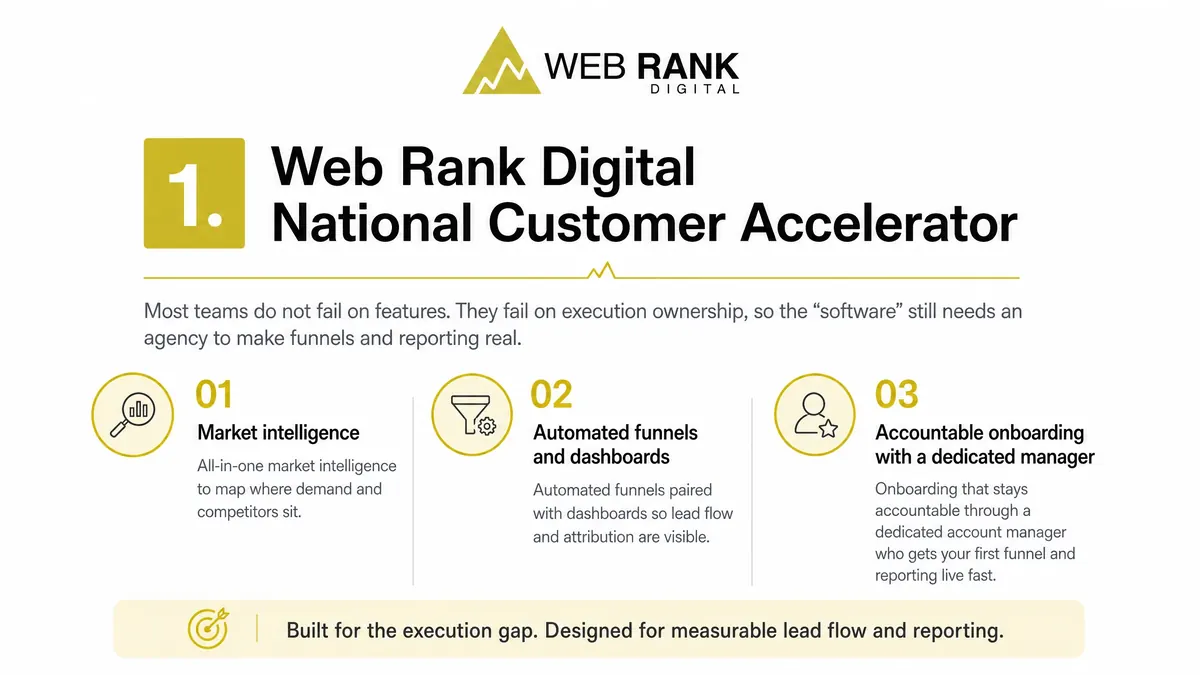
Most teams do not fail on features. They fail on execution ownership, so the “software” still needs an agency to make funnels and reporting real. Web Rank Digital’s National Customer Accelerator is built for that exact gap: all-in-one market intelligence to map where demand and competitors sit, automated funnels paired with dashboards so lead flow and attribution are visible, and onboarding that stays accountable through a dedicated account manager who gets your first funnel and reporting live fast.
2. HubSpot Marketing Hub and Sales Hub
HubSpot Marketing Hub and Sales Hub set the baseline for a broad customer acquisition platform: a strong CRM tied directly to lifecycle automation, so you can move contacts from first touch to SQL to customer without stitching together five tools. Where it wins is the integration ecosystem, with mature connections across ads, email, web forms, calendars, and customer support systems, which keeps data and attribution consistent. The tradeoff is operational: HubSpot performs best when you have in-house operators who can own data hygiene, pipeline design, and workflow governance.
3. Salesforce Sales Cloud plus Marketing Cloud
Salesforce Sales Cloud plus Marketing Cloud is the enterprise standard when you need complex pipelines, strict governance, and multiple teams working the same revenue system. The upside is deep CRM customization: you can tailor objects, fields, automations, and attribution around how your business actually sells, not how a template assumes you sell. Its permissions and data model are built for control at scale, but that control adds design work and testing.
If you worry you are buying software that needs an agency anyway, you are not wrong here: implementation partners are often required, and launch cycles are usually longer.
4. Google Analytics 4
Google Analytics 4 (GA4) will not create demand or send you leads. It tells you, cross channel, what people do after they click: which pages they touch, where they drop, and which sources drive engaged sessions versus empty traffic. For acquisition decisions, GA4 only matters if you set up clean conversion events (forms, calls, booked steps) and confirm attribution settings so your reporting matches how you buy media.
Without strict tagging discipline, GA4 becomes a data landfill and you keep paying for tools that cannot prove impact.
5. Contentsquare
Contentsquare earns its spot when you already have steady traffic and need higher conversion efficiency, not more clicks. Session replay and heatmaps show you where users hesitate, rage click, or abandon, so you stop guessing what “looks fine” and fix what actually breaks conversion. The friction signals and journey insights help you isolate issues like dead-end navigation, confusing forms, or mobile layout gaps across pages and segments.
It is most valuable after volumes are consistent, so patterns are statistically real, not noise.
6. Unbounce
Unbounce earns its keep when you need to ship landing pages fast and prove which message converts before you burn more ad budget. It is built for testing, so you can launch a variant, capture leads, and learn without waiting on a dev sprint. The tool only improves lead flow if you bring clean inputs: a defined traffic source and consistent tracking.
Pair A B tests with forms that pass field data into your CRM, and validate that every click and submission is tagged to the right campaign.
7. Optimizely
Optimizely fits when you are already running serious acquisition testing and need governance, not just a place to spin up A-B tests. You get controls for how experiments are designed, approved, and analyzed so teams do not ship overlapping tests, change success metrics midstream, or lose learnings in dashboards no one trusts.
It also supports personalization plus feature flags, which matters when acquisition gains depend on coordinated web and in-product experiences, controlled rollouts, and clean reversibility. In practice, it is best for mature programs with shared naming, event discipline, and owners for decision-making.
8. Mixpanel
Mixpanel earns its keep when you need proof that a funnel change improved activation, not just more traffic. You instrument key product events, then run event-based funnel analysis to see exactly where users drop, down to the action sequence that precedes conversion.
The second value is cohorts: you group users by what they did (or did not do) and measure retention and activation over time. If your product is not instrumented with consistent event naming and properties, Mixpanel will not fix lead flow. It will only show you the gaps faster.
9. Zapier
Zapier is how you connect point tools fast without hiring an agency to write custom code. You can push new leads from forms, chat, ads, and spreadsheets into your CRM, then trigger lead routing and notifications so speed-to-lead does not depend on someone checking inboxes.
Use it for practical handoffs: assign by territory or service line, alert sales in Slack or email, create follow-up tasks, and log activity where your reporting lives. The caveat is ownership. Zaps break when fields, tags, permissions, or app APIs change, so you need monitoring, clear naming, and a monthly maintenance pass to keep your acquisition flow reliable.
10. Mailchimp
Mailchimp is a practical pick when your acquisition motion depends on email you can ship fast, plus light automation to keep leads warm and bring lapsed customers back. You can launch campaigns quickly, then add basics like welcome series, simple nurture sequences, and cart or browse follow ups. Segmentation is strong enough for promotion targeting by tags, engagement, purchase behavior, or lifecycle stage.
Where it starts to strain is complex multi channel ops: deep cross channel orchestration, advanced routing logic, and enterprise grade attribution usually require a broader platform.
11. ActiveCampaign
ActiveCampaign is a fit when you want segmented nurture that actually changes lead behavior, not just scheduled blasts you pay for and forget. Its email automation builder is the main value: you can route contacts through different sequences based on actions and fields, then keep the messaging tight without enterprise overhead. You also get a light CRM plus lead scoring, which helps sales focus on the right follow-ups and makes handoff cleaner.
The catch is operational discipline: results depend on a clean list and consistent tagging, or your segments drift and automation stops reflecting intent.
12. Marketo Engage
Marketo Engage fits when your revenue depends on disciplined scoring, long nurture arcs, and multi-touch reporting, not quick one-step conversions. You can build advanced scoring that blends behavior and profile signals, then route buyers into role- and stage-specific nurture streams that keep sales cycles moving without constant manual pulls.
It also matches enterprise realities: governance, permissions, auditability, and data-handling controls that reduce “everyone built their own process” drift.
The tradeoff is workload. Setup, taxonomy, and ongoing ops are heavier, and you should plan for dedicated admin time or experienced implementation support, not a weekend launch.
13. Pardot Marketing Cloud Account Engagement
Pardot Marketing Cloud Account Engagement is the cleanest path when you are already standardized on Salesforce CRM and you want B2B automation without breaking your existing routing and ownership rules. Native alignment reduces integration drift because lead, contact, account, and opportunity activity can stay visible in the same system your sales team lives in. You also get B2B nurture basics that operators care about: scoring and grading tied to engagement, plus reporting that connects nurture influence back to pipeline.
Plan for real admin time, though. Initial configuration, field mapping, permissioning, and ongoing governance are not light, and most teams underestimate the overhead.
14. Google Ads
Google Ads is the channel most teams use to capture high intent demand fast, but it only improves lead flow when your landing page, offer, and tracking line up. If you cannot see keyword to lead to closed-won revenue, you are buying clicks, not customers. Set up conversion tracking correctly, then import offline outcomes (qualified lead, booked meeting, sale) so bidding optimizes to real value.
Expect iteration: you will refine match types, negatives, creative, and landing pages to earn spend efficiency.
15. Meta Ads Manager
Meta Ads Manager can create pipeline fast because you can scale prospecting and retargeting in the same system, then push budget toward what is converting. The operators who win keep a testing cadence: rotate new angles weekly, kill ads that stall, and iterate audiences based on what your buyers actually do, not what you assume they like. The real limiter is lead handling speed.
If you are not replying in minutes and booking the next step immediately, the cheapest click still turns into the most expensive lead.
16. LinkedIn Ads
LinkedIn Ads is the go-to channel when your acquisition depends on job title, seniority, company size, industry, and other firmographics you can target directly. That precision is why it performs best for high-value offers where one closed deal covers the media spend, like demos, consultations, or enterprise trials. The tradeoff is cost and volume: higher CPMs and CPLs are common, and you should expect fewer total leads, with more of the budget going to reaching the right decision makers.
17. SEMrush
SEMrush reduces the risk of paying for SEO tools that never improve lead flow by showing you exactly where competitors win visibility and where you can realistically take share, especially in local and regulated markets. You can see which keywords drive their traffic, which pages rank, and where your site is absent or stuck.
It also speeds up content and backlink research: you can reverse-engineer topics that earned rankings and the referring domains that support them.
The limit is execution. Data does not publish pages, earn links, or fix technical blockers, so rankings only move when you turn the gaps into shipped work.
18. Ahrefs
Ahrefs is a best-in-class SEO research tool when your acquisition plan depends on link intelligence. You use it to audit backlink profiles, find link gaps against competitors, and prioritize outreach based on what is already moving rankings in your category. It is also strong for competitor content research, letting you see which pages earn search traffic and links so you can model topics and formats that actually win.
It will not build funnels for you, though. Treat it as research input, then execute in your funnel and reporting stack, including National Customer Accelerator.
Book a demo that proves you can launch fast and track revenue per touchpoint
If you are tired of “top tools” lists that end at the feature checklist, take the next step the operator way. You need to see how quickly your first funnel and dashboard ship, who owns onboarding, and how optimization stays accountable after go live.
In a National Customer Accelerator demo, we tailor the walkthrough to your industry module, your locations, and your monthly lead targets. We show you the exact funnel flow you will deploy and the reporting you will use to measure performance, not just activity.
Bring a short competitor list. We will use it to run market gap analysis and map the first automated funnel to launch during onboarding. Schedule your demo with us and leave with a clear launch plan, timeline, and ownership.